Creative Graphing Projects for Algebra 1 and Geometry
One of my favorite things to do with my Algebra 1 students is a stained-glass graphing project. It combines math, creativity, and a little bit of classroom magic AND it's one of those activities that students remember long after they leave my classroom.
In fact, I recently ran into a few former students who asked me if I still do the stained-glass project. When I told them I did, they got so excited and said, “That was my favorite! I still have mine.”
As teachers, we spend so much time helping students understand the math, so it's pretty special when they remember an activity because they genuinely enjoyed it, too.
Over the years, I've found that creative graphing projects can do more than make math engaging. They can also give students an opportunity to demonstrate mastery without taking a traditional test or quiz.
Let me share how I use these projects in my classroom, some ways to differentiate them, and a few ideas for bringing creative graphing into both Algebra 1 and Geometry.
My Favorite: The Stained-Glass Graphing Project
After my Algebra 1 students have learned all three forms of linear equations and basic transformations, I like to bring those skills together in a creative project.
Students graph 15 or more lines on graph paper, trace their designs onto page protectors, and use permanent markers to color the sections between the lines. The finished projects look like stained glass, and I hang them in the windows of my classroom.
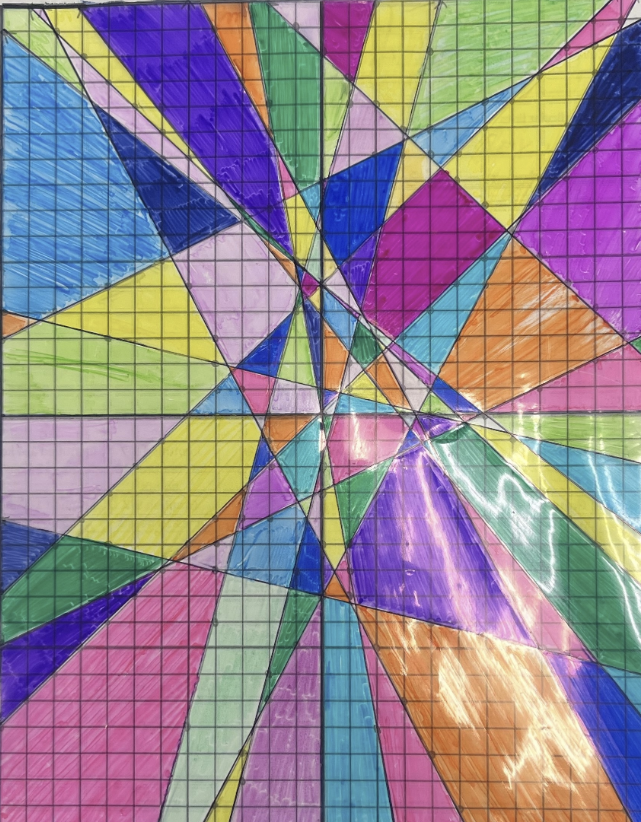
Example of a completed Stained Glass Project
The results are beautiful! But the real value is in the math students have to do to get there.
Students need to write and graph equations accurately, follow directions, and check their work as they progress.
And unlike a traditional worksheet, students end up with something they can display and feel proud of creating.
Using a Graphing Project as a Major or Test Grade
One thing I love about projects is that they give students another way to demonstrate what they know. Not every assessment needs to be a traditional test or quiz.
A well-designed project can require students to apply multiple skills, follow mathematical procedures, and demonstrate their understanding through their finished work.
This year, I knew I wanted to use the stained glass project as a major or test grade. That meant I needed to be intentional about the amount of assistance students could receive.
I wanted students to have the opportunity to create something they enjoyed, but I also needed to assess their individual understanding.
Here's how I structured the project.
Set clear expectations for independent work
Because this was a major grade, students used dividers and worked independently on writing and graphing their equations. I did not allow calculators.
I also broke the project into daily requirements. Each day, students had specific tasks they needed to complete before moving on. This made a larger project feel more manageable and allowed me to monitor their progress along the way.
Give students time to understand the directions
Before beginning each day's work, I gave students five minutes to meet with a group, review their notes, and discuss the math concepts they would need to use that day. They could teach one another, work through examples together, and help clarify concepts anyone was struggling with. Students also had dry-erase markers they could use to work through problems on their desks, but they were not allowed to write anything on their project papers during this discussion time.
After the five minutes were up, students returned to their own work and completed that day's requirements independently. This gave them an opportunity to learn from one another and ask questions before getting started, while still allowing me to assess their individual understanding of the concepts.
I liked this approach because it allowed students to clarify the directions without having someone else complete the mathematical thinking for them.
Consider allowing a limited number of questions
Another option would be to allow each student to ask you three questions throughout the project.
If you choose this approach, I would be very clear about what qualifies as an appropriate question. Otherwise, students may use their questions to ask you to do the math for them.
For example, I would not answer:
“What is the slope-intercept form of this standard form equation?”
That would require me to do the actual work the student is supposed to demonstrate.
However, I would answer:
“I don't remember how to convert to slope-intercept form. Will you walk me through an example?”
That question gives me an opportunity to clarify the process using a different example without solving the student's assigned problem.
I would establish these expectations before starting the project so students understand what kind of help is available and what they are responsible for doing independently.
Of course, the amount of support you allow should depend on your learning objectives and what you intend the grade to measure.
Differentiating Graphing Projects for Your Students
Another reason I love these projects is how easy they are to differentiate.
You don't have to give every student exactly the same equations or require every student to complete the same number of lines. You can maintain the same overall goal while adjusting the work to meet individual needs.
Here are a few options:
Adjust the difficulty of the equations. Provide equations that are more straightforward for students who need additional support and more challenging equations for students who are ready to extend their learning.
Change the number of lines. Some students may demonstrate mastery with fewer equations, while others may be ready to complete more.
Offer different levels of challenge. You can vary the equation forms, slopes, intercepts, or transformations students need to apply.
Provide appropriate supports. Depending on your assessment goals, you might allow students to use notes, provide worked examples, or offer more structured directions.
The important thing is to decide what you want to assess. If the goal is for students to independently write and graph equations, you can adjust the difficulty or quantity without removing that expectation.
If you want to make grading easier, another option is to select the equations for students ahead of time and create your own completed graph as a reference. This gives you a consistent way to check their work without having to solve every equation from scratch while grading.
No Classroom Windows? No Problem!
If your classroom doesn't have suitable windows, you can still create a beautiful display.
Place a sheet of white or light blue paper inside each page protector before hanging the finished projects on a bulletin board. The light background creates a wonderful stained-glass effect, and the colorful designs make a fantastic classroom display.
It's a great way to showcase student work and add some personality to your math classroom.
Graphing Projects for Other Math Concepts
Because I love the stained glass project so much, I wanted to create similar activities that could be used with other math concepts and grade levels.
I've created smaller projects focused on proportional relationships and slope-intercept form. These allow students to practice specific skills while still enjoying the creative process.
I also teach Geometry, so I wanted to bring that same energy into my geometry classroom.
One of my favorite additions is a fall-themed jack-o'-lantern project. Instead of being given all the equations, students have to write their own equations to create their designs. The project also incorporates parallel and perpendicular lines and lines cut by a transversal.
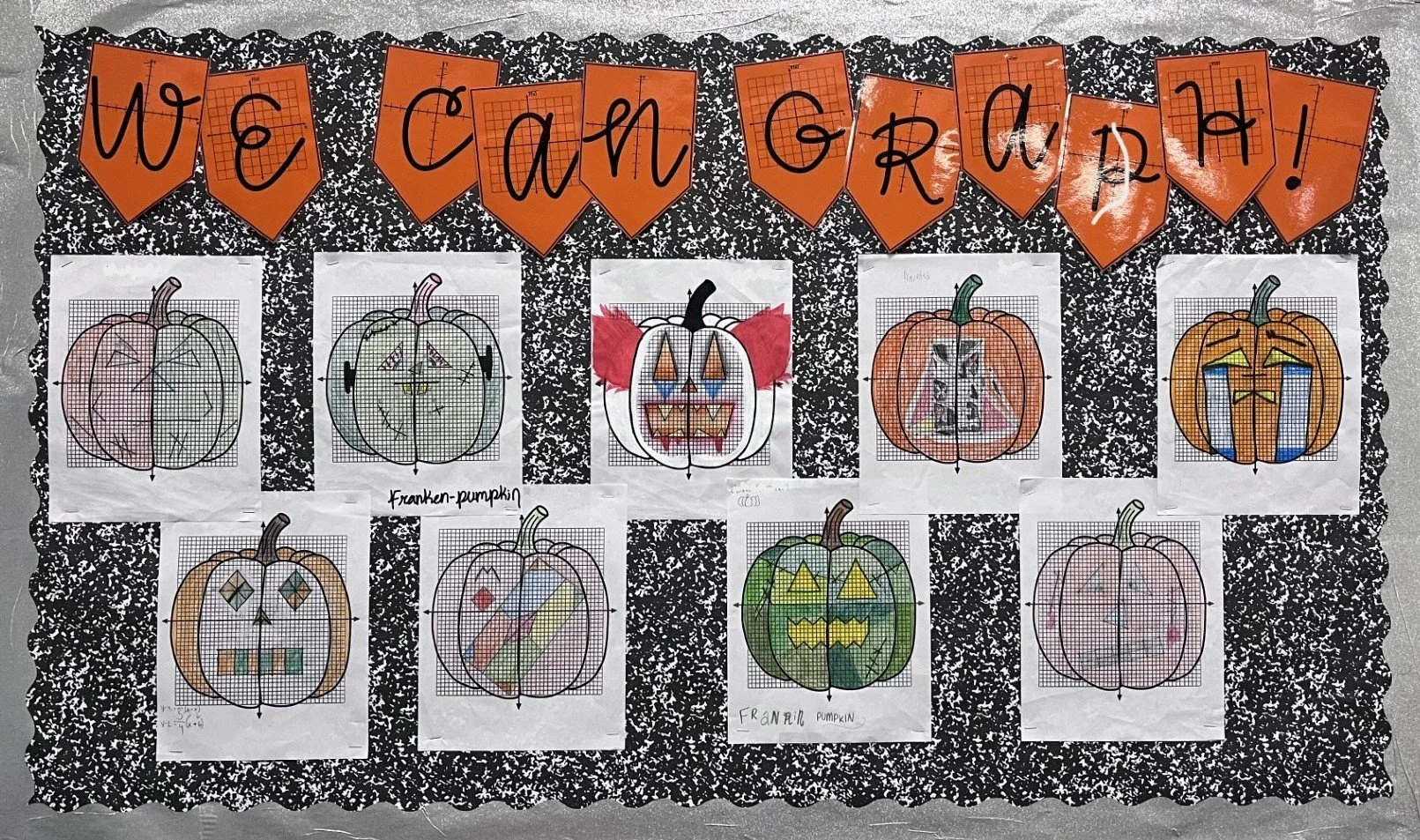
Jack O’ Lantern Project Bulletin board. (Letters are also available in my store.)
My Geometry students were so excited to create their jack-o'-lanterns this year!
I love seeing students get invested in an assignment while applying several important concepts along the way. Depending on your learning objectives, a project like this can also give students an opportunity to demonstrate how well they can connect different math concepts.
Why I Keep Coming Back to Creative Math Projects
As teachers, we know students need meaningful practice and opportunities to show what they know. But that doesn't mean every assessment has to be a worksheet, test, or quiz.
Creative graphing projects can give students a different way to demonstrate their understanding while making choices, solving problems, and creating something meaningful.
They also offer flexibility. You can adjust the equations, the number of problems, the level of support, and the expectations to meet your students' needs.
And when students can see how their mathematical work contributes to a finished product, the process can feel more purposeful than completing one problem after another.
Sometimes, the best evidence that an activity is worth repeating comes years later, when a former student still remembers it as a favorite.
Explore the Graphing Projects
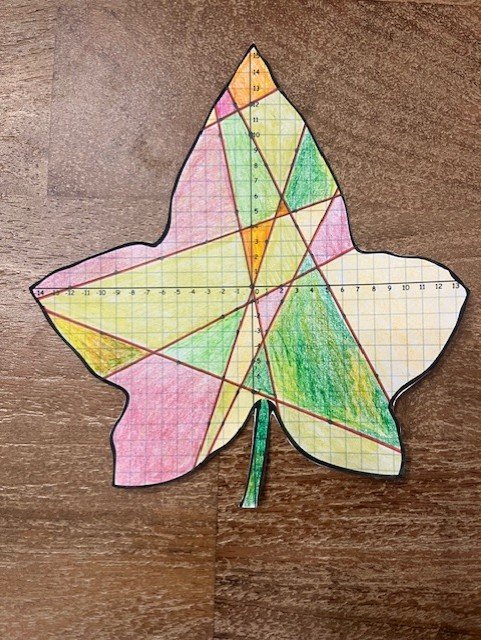
Example of Fall Themed Graphing Project
All of my fall-themed graphing projects, along with the original stained-glass project, are available now at The Algebrista.
Whether you're teaching linear equations in Algebra 1, reviewing proportional relationships, or looking for a creative way to practice geometry concepts, these projects offer an opportunity to bring math and creativity together.
New themes and projects are coming soon, so check back for future additions!
Happy graphing!
Jessica
The Algebrista