Things you’ll Love!
Explore the resources and services that will help build the math confidence we all want!
Classroom Resources
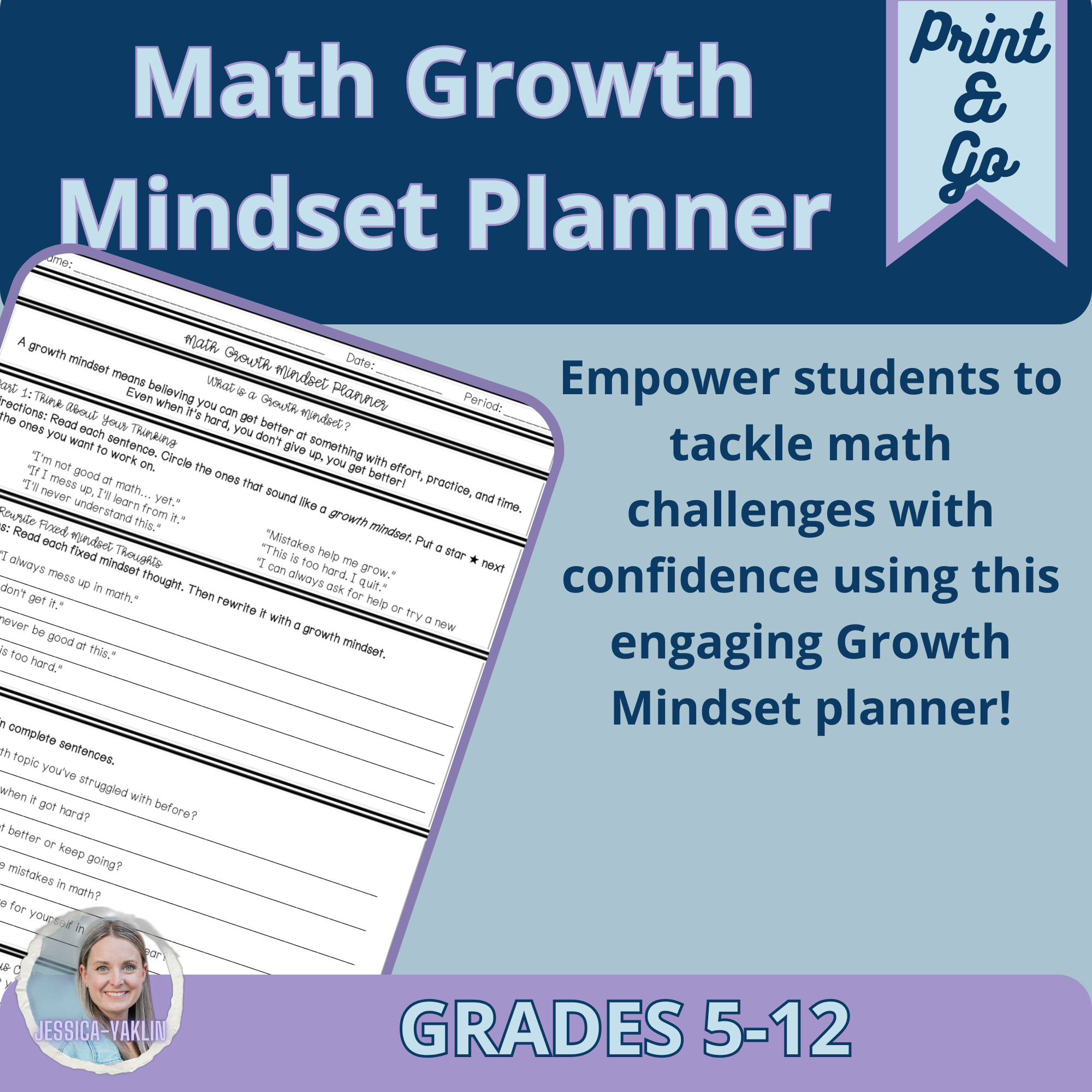
Strengthen math confidence and nurture a positive classroom culture with this Growth Mindset in Math Worksheet. Students reflect on their beliefs about learning, practice reframing fixed‑mindset thoughts, and build empowering self‑talk strategies that support resilience and perseverance. Through guided prompts and SEL‑aligned activities, learners develop the mindset they need to approach challenges with confidence and curiosity.
This Growth Mindset Worksheet blends meaningful reflection with practical mindset skill‑building. Students begin by completing a mindset check‑in using relatable statements about their math experiences. As they move through each section, they compare fixed and growth mindset thinking, rewrite negative thoughts into productive ones, and respond to guided reflection questions that deepen their understanding of how mindset affects learning. The activity concludes with a positive affirmation starter, “I can…” that encourages students to internalize their strengths and set actionable goals.
Students stay engaged because they can see their thinking shift. Each prompt encourages honest reflection, supportive self‑talk, and intentional goal‑setting, reinforced by structured questions that help students articulate how their mindset influences their math journey.
This resource is fully print‑and‑go, making it ideal for busy classrooms, intervention groups, or low‑prep SEL routines.
What’s Included
Growth mindset check‑in — relatable student statements that spark reflection
Fixed vs. growth mindset practice — students reframe negative thoughts into empowering ones
Guided math reflection questions — prompts that deepen understanding and build self‑awareness
Positive affirmation starter — “I can…” statements that promote perseverance
Ready‑to‑print PDF — low‑prep, black‑and‑white format for easy classroom use
Learning Objectives
Students will:
Reflect on their current math mindset
Identify fixed vs. growth mindset thinking
Reframe negative thoughts into productive self‑talk
Develop positive affirmations that support perseverance
Build confidence through SEL‑aligned reflection
How to Use This Resource
This worksheet works beautifully as a standalone SEL activity, a mindset reset, or a recurring reflection tool throughout the year.
Students begin with a mindset check‑in, then move into fixed‑vs‑growth mindset practice where they rewrite limiting thoughts. Next, they respond to guided reflection questions that help them connect mindset to their math habits. The activity wraps up with a positive affirmation that can be displayed, shared, or revisited during future lessons.
Perfect for:
Back‑to‑school routines
New Year goal‑setting
Morning meeting SEL integration
Math intervention or small‑group support
The Pedagogy: Why It Works
Growth mindset becomes far more meaningful when students actively examine their beliefs and practice shifting their thinking. This worksheet guides students through intentional reflection, helping them recognize unproductive thoughts and replace them with strategies that support persistence.
The combination of mindset check‑ins, reframing practice, and affirmation writing supports multiple learning modalities. Students build emotional awareness, strengthen their self‑talk, and develop a healthier relationship with math. The final affirmation provides a sense of ownership and pride while reinforcing the belief that effort leads to growth.
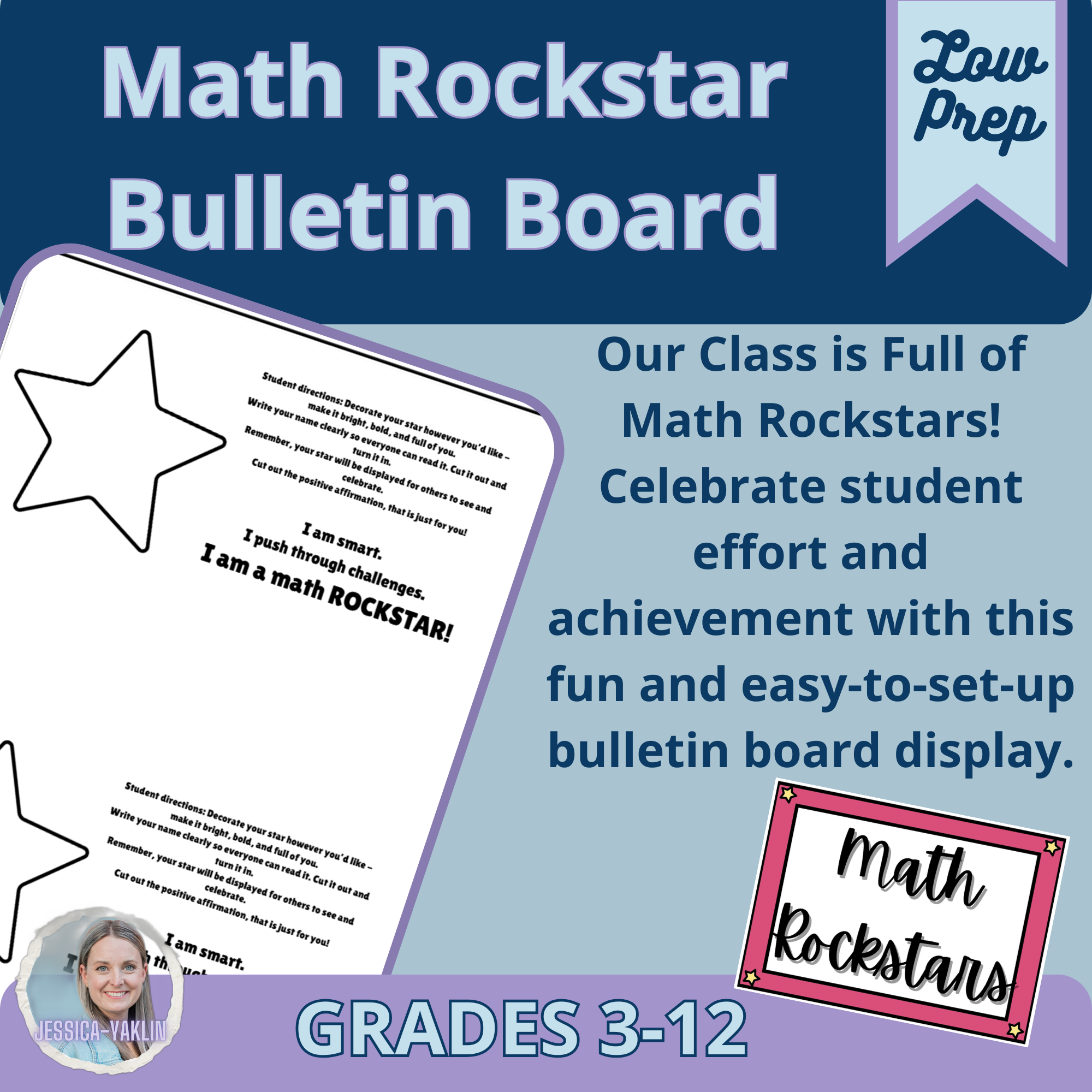
Strengthen math confidence and build a joyful, encouraging classroom culture with this Math Rockstar Positive Affirmation & Growth Mindset Bulletin Board. This resource celebrates students for who they are, what they’re working toward, and the growth they show every day. Whether you use it as a year‑long tradition or a quick confidence‑boosting activity, it helps students feel seen, valued, and proud of their progress.
Students decorate their own Rockstar Star, personalize it with strengths, goals, and achievements, and keep a private positive affirmation just for themselves. As the bulletin board fills with student stars, your classroom becomes a visual reminder that effort, perseverance, and self‑belief matter.
This resource is flexible enough for any classroom routine—use it for milestone celebrations, weekly reflections, sticker‑based progress tracking, or as part of your SEL and growth mindset instruction.
What’s Included
Student‑friendly star templates students color, decorate, and personalize
Positive affirmation strips (“I am smart. I push through challenges. I am a math ROCKSTAR!”) students cut out and keep
Teacher‑led student directions for decorating, reflecting, and displaying their stars
Three display options: Milestone Stars, Sticker Progress Stars, or fully customizable routines
Growth mindset connection that pairs perfectly with your reflection worksheet
Learning Benefits
Students will:
Celebrate personal strengths, goals, and achievements
Build confidence through positive self‑talk and affirmations
Reflect on growth—big or small
Strengthen perseverance and effort‑based thinking
Contribute to a supportive, uplifting classroom community
Why It Works
Growth mindset becomes powerful when students can see their progress. This bulletin board turns reflection into a meaningful visual celebration. As students decorate their stars, they engage in identity‑building SEL work—recognizing strengths, naming goals, and practicing positive self‑talk.
“Encourage them to make it all about them, their strengths, goals, achievements, or growth.” “This option works great for tracking growth over time and reinforcing consistency.”
The included affirmation (“I am smart. I push through challenges. I am a math ROCKSTAR!”) reinforces resilience and helps students internalize the belief that effort leads to growth.
Classroom Use Ideas
Back‑to‑school identity activity
Weekly or monthly milestone celebrations
SEL check‑ins
Math confidence‑building routines
Hallway display for family nights or open house
Small‑group intervention motivation
🔗 Want to build a full mindset routine?
Try pairing this with your Growth Mindset Reflection Worksheet.
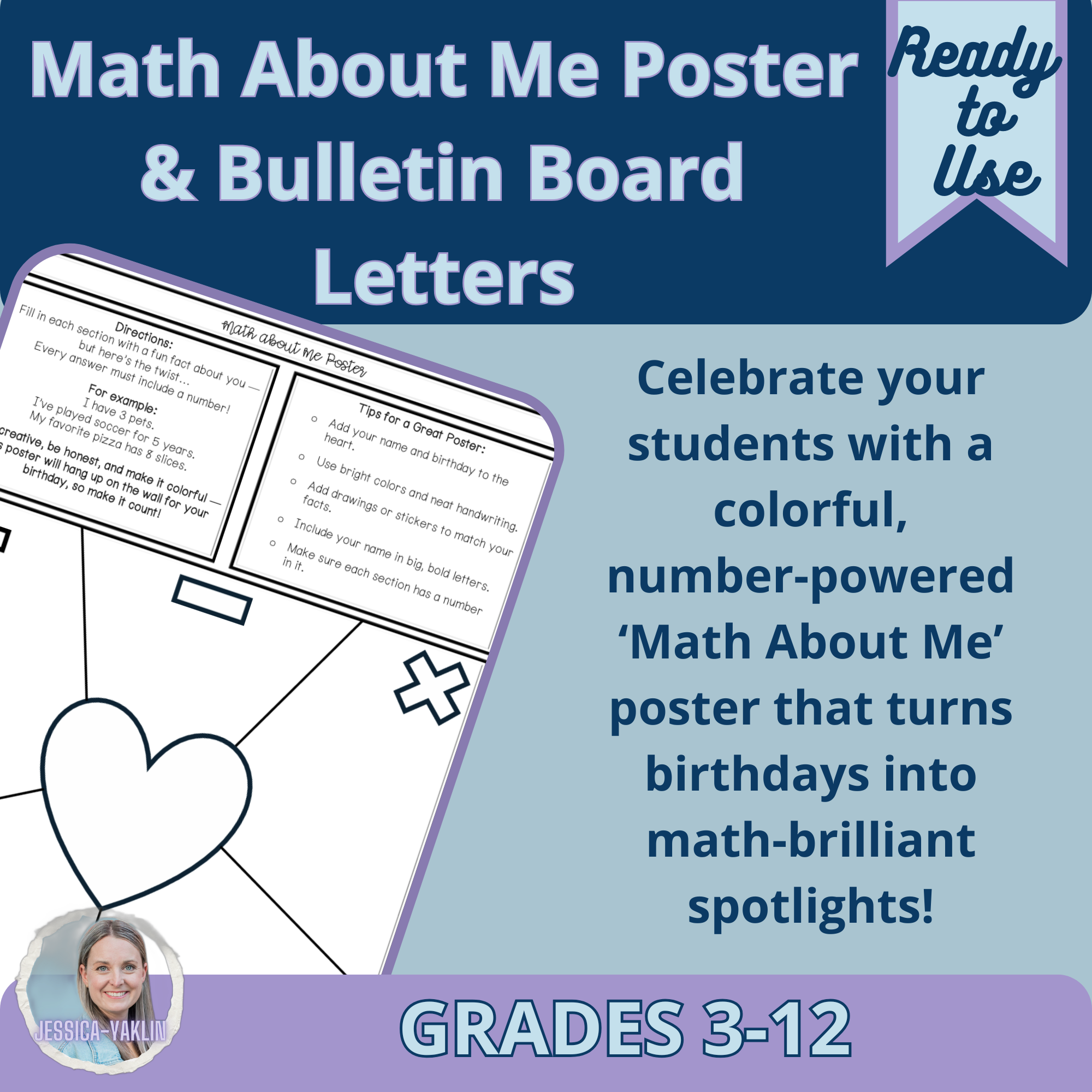
Build confident mathematicians and strengthen classroom community with Math About Me: A Number‑Powered Student Poster. This resource helps students express who they are through numbers, turning personal facts into meaningful math connections. Whether during back‑to‑school activities, birthday spotlights, advisory, or hallway displays, students learn to share their stories in creative, math‑rich ways.
Students explore fun prompts like People Math, Favorites by the Numbers, and My Perfect Equation—helping them see that math is part of their everyday lives.
These guided sections support students in expressing themselves, building confidence, and contributing to a classroom culture where everyone’s story matters.
What’s Included
Math‑themed poster template with six number‑based prompts
Two versions of student directions for flexibility and clarity
Tips for creating a polished final poster
2 Bullet Board Letter Options "Math About Me" and "It's My Birthday!"
Learning Objectives
Students will:
Use numbers to describe themselves in meaningful, personal ways
Strengthen number sense through real‑life connections
Build classroom community by sharing and celebrating their stories
Practice creativity, ownership, and self‑expression
Contribute to rotating displays that highlight student identity
This poster fits beautifully into your classroom routines, especially during:
Beginning‑of‑year get‑to‑know‑you activities
Monthly birthday bulletin boards
Advisory, morning meeting, or SEL time
Hallway or classroom displays
First‑week icebreakers or math‑identity lessons
Have students complete their posters during the first week of school, then feature new posters each month as birthdays roll in—creating a rotating, student‑centered display that stays fresh all year.
The Pedagogy: Why It Works
Students engage more deeply when math feels personal. This resource helps them see numbers as part of their identity—ages, favorites, hobbies, milestones, and more. By connecting math to their real lives, students build confidence, reduce math anxiety, and feel proud of the stories they share. It also supports multilingual learners and students who benefit from structured, creative prompts.
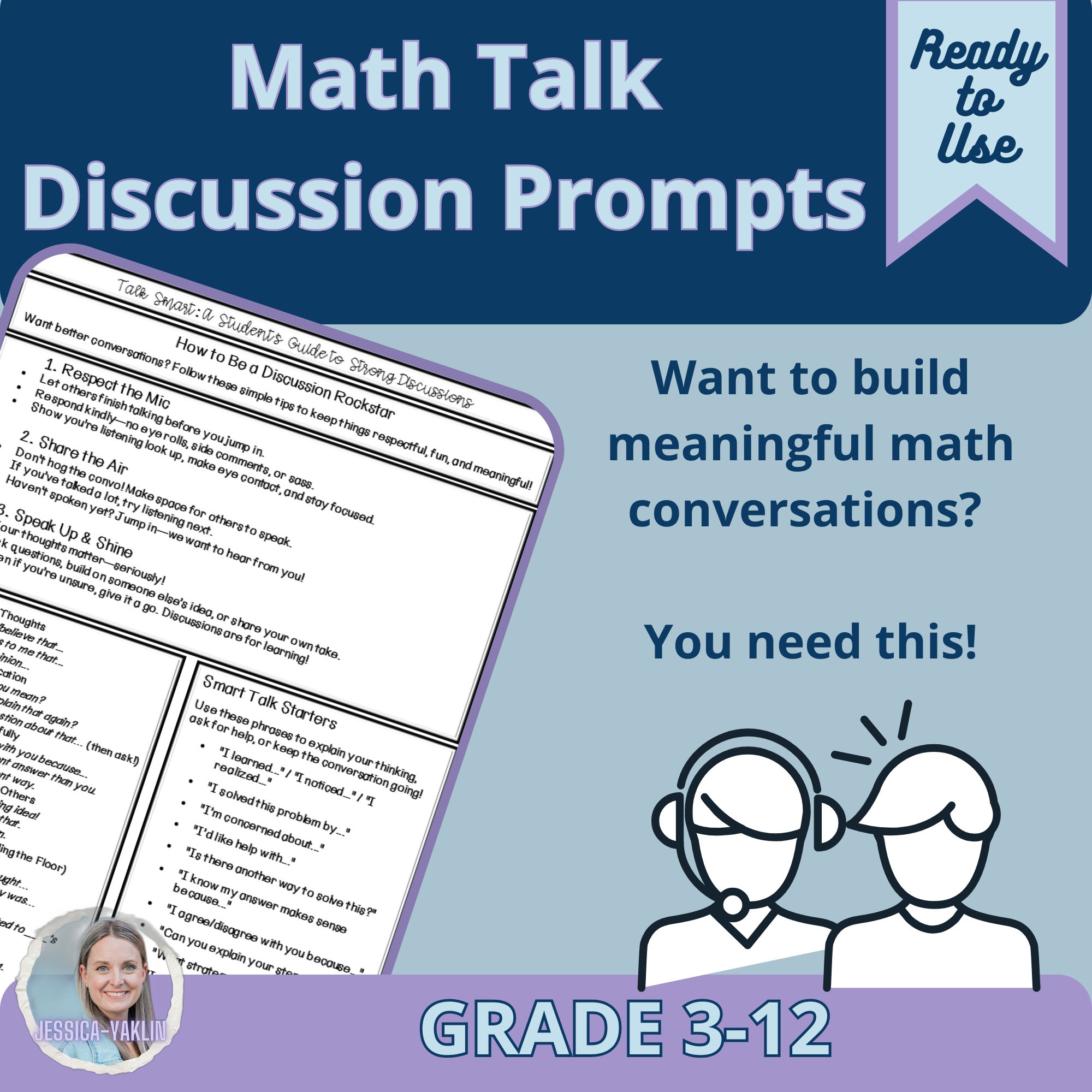
Build confident communicators and strengthen classroom discourse with Talk Smart: A Student’s Guide to Strong Discussions. This resource teaches students how to participate in meaningful, respectful, and productive conversations. Whether during math talks, literature circles, group work, or whole‑class discussions. With clear expectations, student‑friendly sentence starters, and practical communication tools, learners develop the skills they need to listen actively, speak thoughtfully, and collaborate with confidence.
Students learn how to “Respect the Mic,” “Share the Air,” and “Speak Up & Shine.”
These guidelines help students understand not just what to say, but how to say it in ways that build community and deepen learning.
What’s Included
Discussion expectations organized into three student‑friendly pillars: Respect the Mic, Share the Air, Speak Up & Shine
Sentence starters for sharing ideas, asking questions, disagreeing respectfully, affirming peers, and staying on track
Smart Talk Starters that help students explain their thinking, ask for help, and reflect on their strategies
Printable Bulletin Board Letters and Thought Bubbles for classroom display
Student‑friendly language that supports SEL, collaboration, and academic conversations
Learning Objectives
Students will:
Practice active listening and respectful communication
Participate in discussions with confidence and clarity
Use sentence starters to express ideas, ask questions, and build on others’ thinking
Strengthen academic vocabulary and discourse skills
Develop habits that support collaborative learning
How to Use This Resource
This guide works beautifully as part of your classroom routines, especially during:
Math talks and problem‑solving discussions
Literature circles and Socratic seminars
Group projects and partner work
Morning meeting or advisory
Beginning‑of‑year community building
Post the expectations, model the sentence starters, and refer back to them throughout the year to reinforce strong communication habits.
The Pedagogy: Why It Works
Students participate more meaningfully when they know how to communicate. This resource breaks discussion skills into simple, actionable steps that students can immediately apply.
By giving students language for sharing ideas, disagreeing respectfully, and connecting to others, you help them build confidence and reduce the anxiety that often comes with speaking in front of peers. The sentence starters also support multilingual learners and students who benefit from structured communication scaffolds.
🔗 Want to build a full communication toolkit?
Explore more SEL‑aligned classroom resources or pair this with my Growth Mindset Worksheet to support confident, reflective learners.
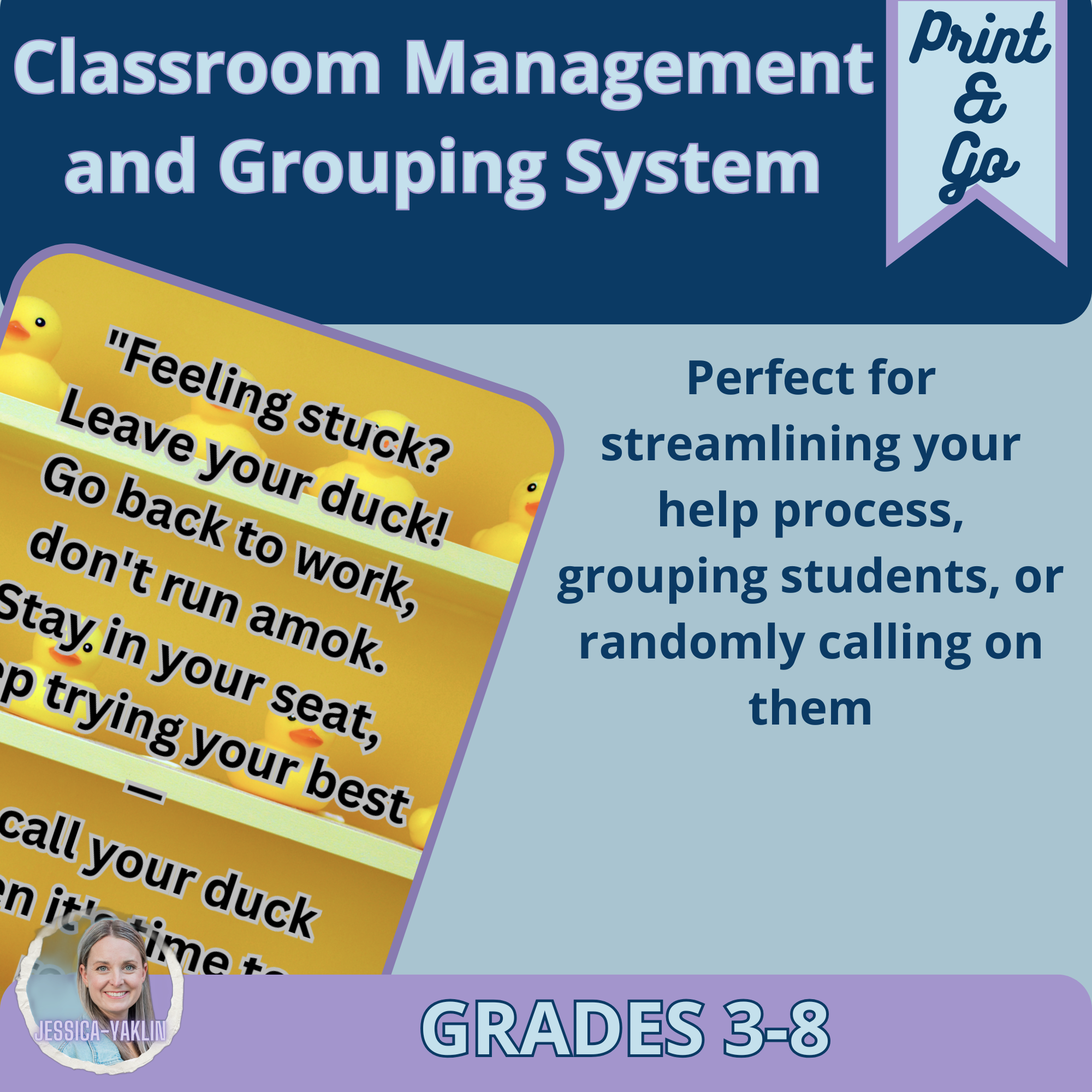
Transform classroom interruptions into independent problem-solving with this When You're Stuck, Leave Your Duck! Classroom Management & Student Engagement Kit. This fun, duck-themed classroom management system helps students learn to persevere while giving teachers an organized, stress-free way to manage help requests. Instead of students lining up at your desk or calling your name, they simply leave their numbered duck, return to work, and wait for their turn.
But the ducks don't stop there! This versatile resource also doubles as a random student selector, cooperative learning grouping tool, classroom management system, and formative assessment resource. Whether you're teaching math, science, ELA, or social studies, this classroom-tested engagement kit keeps students actively involved while creating smoother classroom routines.
Students quickly learn that being stuck doesn't mean stopping—it means trying, thinking, and trusting that help is on the way.
What's Included
Complete "Leave Your Duck" help request system with easy teacher directions
Printable numbered duck cards (1–36) for student and teacher sets
Three printable classroom reminder signs with fun rhyming poems
Step-by-step setup instructions
Multiple classroom management and engagement ideas
Random student calling system
Flexible partner and cooperative learning grouping strategies
Bonus ideas for classroom voting, formative assessment, behavior management, brain breaks, student reflection, and more
Learning Benefits
Students will:
Develop perseverance before asking for help
Build independence and productive struggle habits
Practice waiting appropriately while continuing to work
Stay engaged instead of waiting in line for teacher assistance
Participate more confidently during whole-class discussions
Collaborate with a variety of classmates through flexible grouping strategies
Why It Works
One of the biggest classroom management challenges is helping students get the support they need without creating long lines, repeated interruptions, or lost instructional time. The "Leave Your Duck" system creates a predictable routine that encourages students to keep thinking while they wait for teacher support.
Instead of stopping their work, students simply leave their duck in the help tray and continue working independently. Teachers can easily see who needs assistance while maintaining the flow of instruction. This simple routine builds resilience, encourages productive struggle, and helps students become more confident problem solvers.
The included teacher duck set also becomes an incredibly flexible classroom tool for random student selection, cooperative learning groups, classroom discussions, exit tickets, and countless engagement activities throughout the school year.
Classroom Use Ideas
Classroom help request system
Random student calling
Cold calling during lessons
Exit tickets and classroom discussions
Cooperative learning groups
Partner matching activities
Classroom voting and polls
Check-for-understanding routines
Brain break selector
Positive behavior reinforcement
End-of-class check-out routine
Back-to-school classroom procedures
Perfect For
Middle school math classrooms
Upper elementary classrooms
Intervention groups
Any subject area
New teachers building classroom routines
Veteran teachers looking to increase student independence
🔗 Want to build even stronger classroom routines? Pair this resource with my Growth Mindset activities, classroom management resources, and student reflection tools to create a classroom where students build confidence, perseverance, and independence all year long.
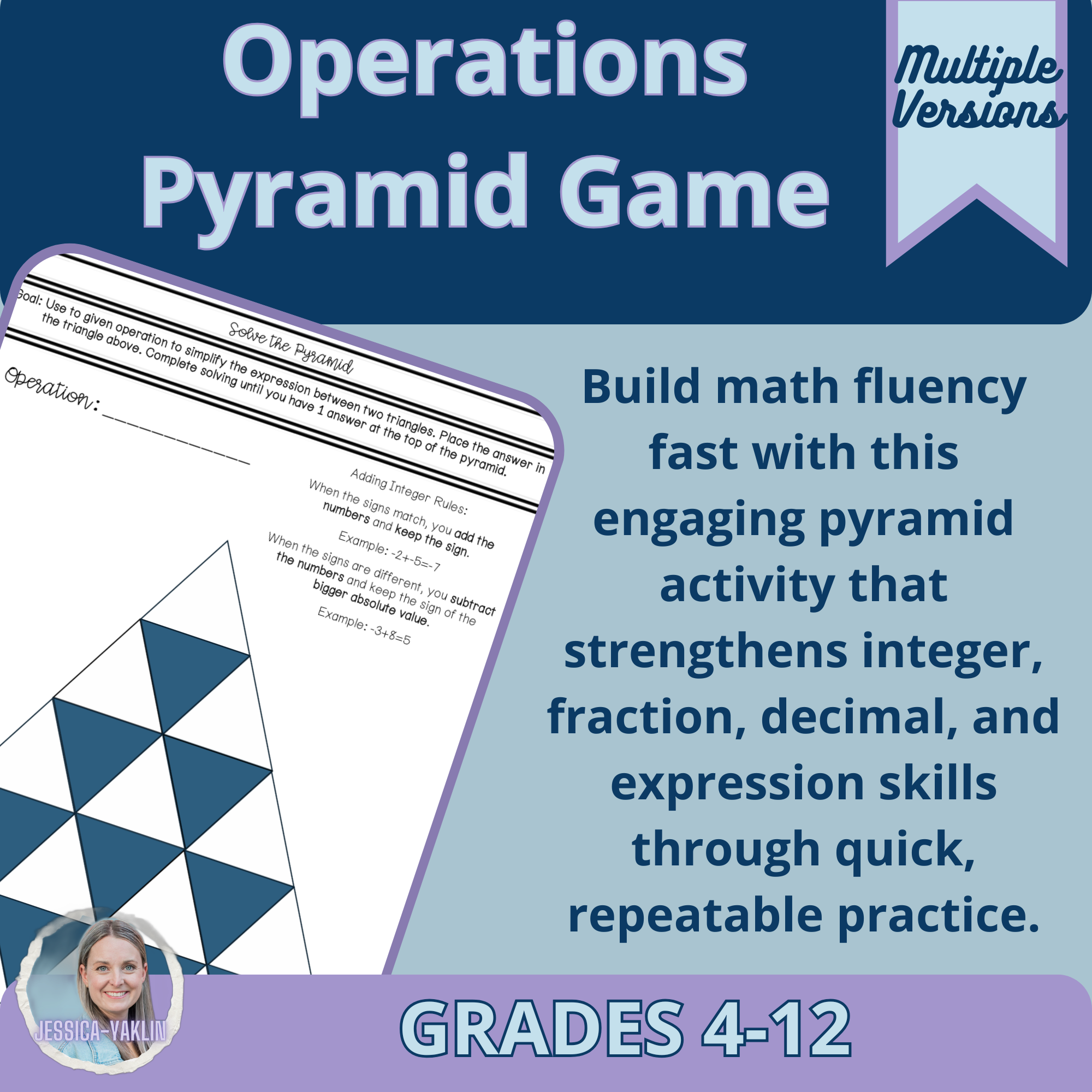
Turn everyday operations practice into an engaging, strategy‑building challenge with this Solve the Pyramid Math Activity. Students begin with five numbers (integers, fractions, decimals, or expressions) and use a single operation to simplify each pair as they work their way to the top of the pyramid. This hands‑on structure helps students build fluency with integer operations, fraction computation, decimal operations, and simplifying expressions while reinforcing accuracy and step‑by‑step reasoning.
This Solve the Pyramid resource blends computation, critical thinking, and repetition in a way that keeps students motivated. Each new row depends on the accuracy of the previous one, encouraging careful work and attention to detail. Students can use teacher‑selected numbers or generate their own by rolling dice, drawing cards, or spinning number wheels. The activity is flexible enough for warm‑ups, stations, fast‑finishers, or skill‑building practice during any unit.
Students stay engaged because the pyramid format turns routine practice into a puzzle‑like challenge. They can visually track their progress as each simplified answer builds toward the final result at the top. The structure naturally supports differentiation. Teachers can adjust the difficulty by choosing the types of numbers or expressions students begin with.
This resource is print‑and‑go and easy to implement, making it ideal for busy classrooms, intervention groups, or homeschool settings.
What’s Included
Clear, student‑friendly directions on every page
Multiple pyramid templates for repeated practice
Versions for integers, fractions, decimals, and expressions
Operation rule reference sheets (adding, subtracting, multiplying integers; decimals; fractions; combining like terms)
A completed example pyramid for modeling
Learning Objectives
Students will:
Apply operations with integers, fractions, decimals, or expressions
Strengthen accuracy and fluency with rational number computation
Use operation rules to simplify expressions step‑by‑step
Build reasoning skills by working through a structured, layered problem
Demonstrate understanding through repeated, scaffolded practice
How to Use This Resource
This activity works well as a warm‑up, math station, partner challenge, or fast‑finisher task. Students begin by filling in the bottom row with five numbers. Using the assigned operation, they simplify each pair and record the result in the triangle above. The process continues until they reach the top of the pyramid. Teachers can differentiate by selecting the number types or allowing students to generate their own using dice, cards, or spinners. The repeated structure makes this activity perfect for ongoing practice throughout the year.
The Pedagogy: Why It Works
Students build procedural fluency through structured repetition, but the pyramid format adds a layer of strategy and engagement. Each answer depends on the previous one, encouraging precision and reinforcing the logic behind operations. The activity supports mastery of integer rules, decimal alignment, fraction equivalence, and combining like terms in a visual, scaffolded way. Because the task is quick, repeatable, and adaptable, it becomes a powerful tool for reinforcing foundational skills all year long.
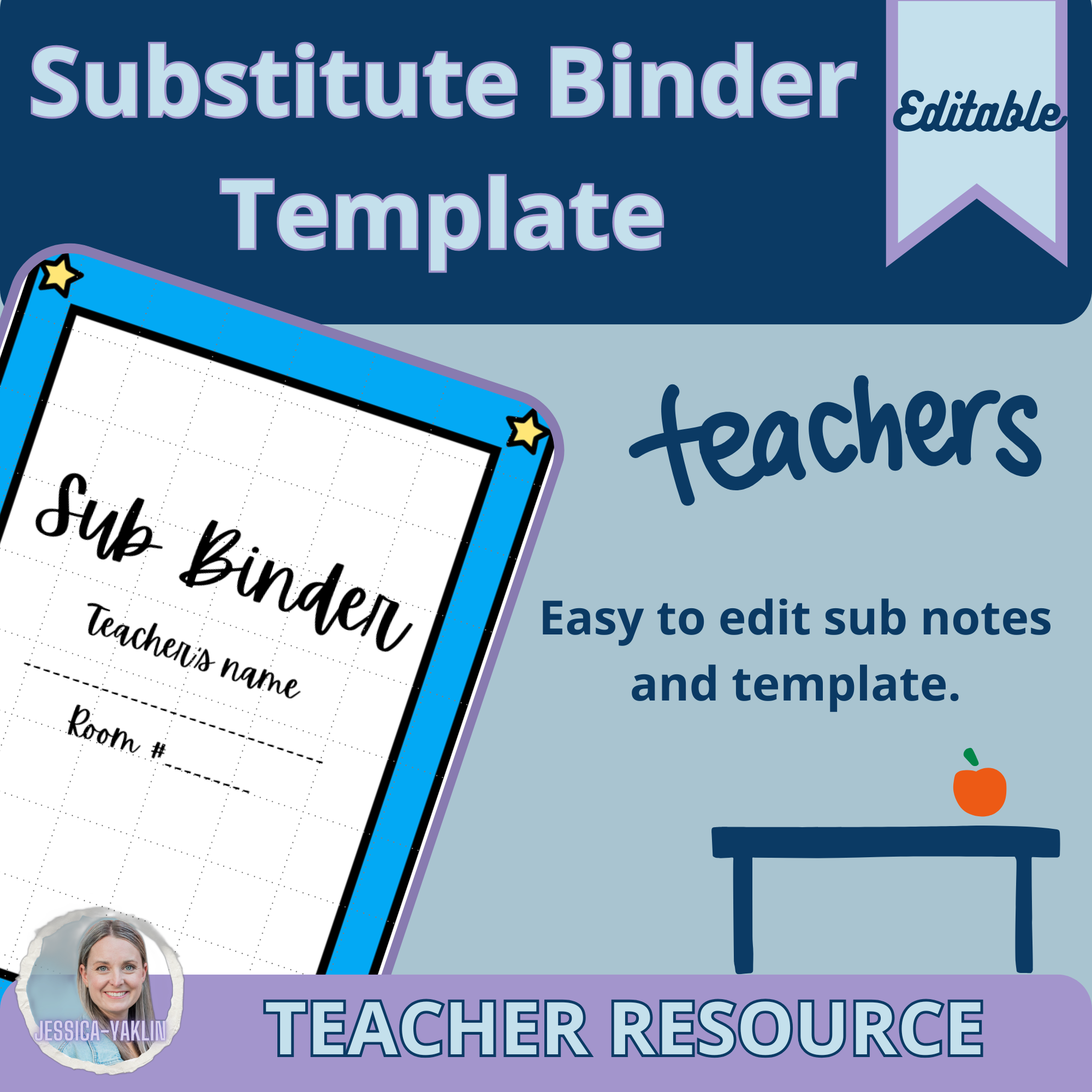
Editable Middle School Sub Binder Template | Emergency & Sick Day Sub Plans
Make preparing for a substitute a little less stressful with this editable Middle School Sub Binder! Whether you're planning ahead for a personal day or scrambling to prepare for an unexpected sick day, this resource helps you organize the important information your substitute needs to keep your classroom running smoothly.
Designed with middle school teachers in mind, this printable and editable binder includes pages for your daily schedule, classroom procedures, helpful students, technology information, emergency procedures, and more. Simply customize the pages with your own classroom information, print them, and keep them ready for whenever you need to be absent!
What's Included:
Editable Sub Binder Cover Page
Welcome Letter for Your Substitute
Daily Schedule and Class Period Template
Helpful Information Page, including space for:
Rosters or seating chart locations
Helpful students
Classroom management tips
Students to keep an eye on
Technology logins and helpful hints
Bathroom, water, and phone policies
Emergency procedures and location of plans
Early finisher ideas
Sub Report Pages for notes from each class period
Why Teachers Love It:
✔️ Be prepared for unexpected absences without starting from scratch
✔️ Keep important classroom information in one organized place
✔️ Help substitutes feel more confident and prepared in your classroom
✔️ Customize the binder to fit your classroom needs
✔️ Use it year after year by updating your information as needed
How to Use:
Open the editable PowerPoint file.
Customize the pages with your classroom information.
Save your completed binder.
Print the pages and place them in a binder.
Keep your Sub Binder ready for your next planned or unexpected absence!
File Information:
This resource includes an editable PowerPoint (.pptx) file. You can customize the text and information to fit your classroom before printing.
Please note: This is a digital product. No physical item will be shipped.
Whether you're preparing for a planned absence, organizing your emergency sub plans, or simply trying to make future sick days a little easier, this editable Sub Binder helps you feel prepared—and gives your substitute the information they need to confidently take care of your classroom.
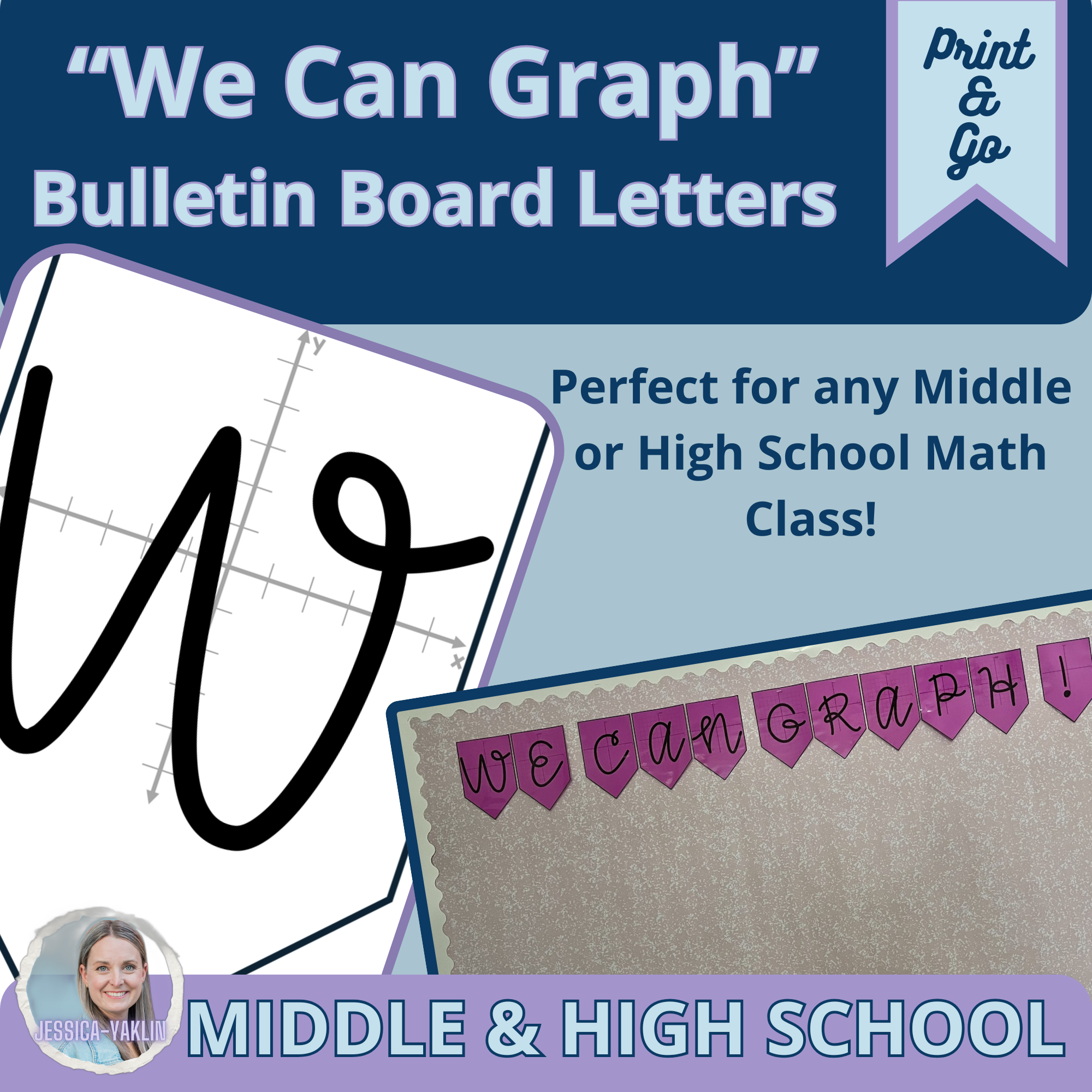
Build an eye-catching math classroom display with “We Can Graph” Math Bulletin Board Letters. These math-themed uppercase letters help you create a bulletin board, classroom door display, or hallway display that celebrates the many ways students encounter graphs throughout their math journey. Whether you're introducing graphing in middle school or reinforcing advanced Algebra, Precalculus, or Calculus concepts, these letters create a colorful visual that sparks curiosity and reinforces mathematical thinking.
Each uppercase letter measures approximately 7 inches tall and features a graph behind each letter. Simply print the letters on any color paper using black ink, cut them out, and create a customized display that fits your classroom.
Need smaller letters? Easily adjust the print scale in your printer settings to create the perfect size for your bulletin board, classroom door, or wall display.
What's Included
Uppercase math-themed bulletin board letters to spell "We Can Graph"
Letters featuring a banner shape and graph on each letter
Black-ink only design for printing on any color paper
Printable PDF that can be resized for different display needs
Perfect For
Graphing unit bulletin boards
Middle School math, Algebra 1, Geometry, Algebra 2, Precalculus, and Calculus classrooms
Back-to-school classroom displays
Math classroom doors
Hallway displays
STEM and math department decorations
Year-round classroom decor
Why It Works
A classroom environment that celebrates mathematics helps students see connections across topics and grade levels. Displaying "We Can Graph" reinforces that graphing is a powerful tool used throughout mathematics—from number lines and linear functions to trigonometric, logarithmic, and polynomial functions. This visual reminder encourages mathematical thinking, supports classroom discussions, and creates an engaging learning environment that inspires curiosity every day.

Transform the first days of school into a meaningful goal-setting experience with this Back-to-School Goal Setting Coloring Sheet! This engaging back-to-school activity encourages students to reflect on their hopes for the new school year, set personal goals, and develop a growth mindset, all while creating a colorful keepsake, they'll be proud to display.
Perfect for elementary, middle, and high school classrooms, this low-prep printable combines creativity, social-emotional learning, and student reflection to help build a positive classroom community from day one.
What's Included
Student goal-setting coloring sheet
Student-friendly goal writing prompts
Creative coloring activity for personalization
Print-and-go format for easy classroom use
Perfect for bulletin board displays and classroom décor
Learning Benefits
Students will:
Reflect on their strengths and goals for the new school year
Set meaningful academic or personal goals in a student-friendly format
Develop self-awareness and a growth mindset
Express creativity while designing a personalized keepsake
Build excitement and confidence for the year ahead
Why It Works
The beginning of the school year is the perfect time to help students develop positive habits and focus on future success. This goal-setting activity encourages students to think intentionally about what they hope to accomplish while reinforcing the idea that growth comes through effort, perseverance, and learning from challenges.
The coloring component keeps students engaged while creating a meaningful display that serves as a year-long reminder of the goals they set for themselves. It's an easy way to combine social-emotional learning, reflection, and classroom community-building into one memorable activity.
Classroom Use Ideas
Back-to-school activity
First week of school
Morning work or bell ringers
Advisory or homeroom
SEL lessons
Goal-setting conferences
Bulletin board displays
Perfect For
Elementary classrooms
Middle school classrooms
High school classrooms
Homeschool learning
Advisory and homeroom teachers
Counselors
Any teacher looking to build a positive classroom culture
Pair It With
Create a classroom culture focused on confidence, perseverance, and growth by pairing with two other resources. Step 1: Math Rockstar Step 2: Growth Mindset WorksheetStep 3: This Goal Setting Coloring Sheet
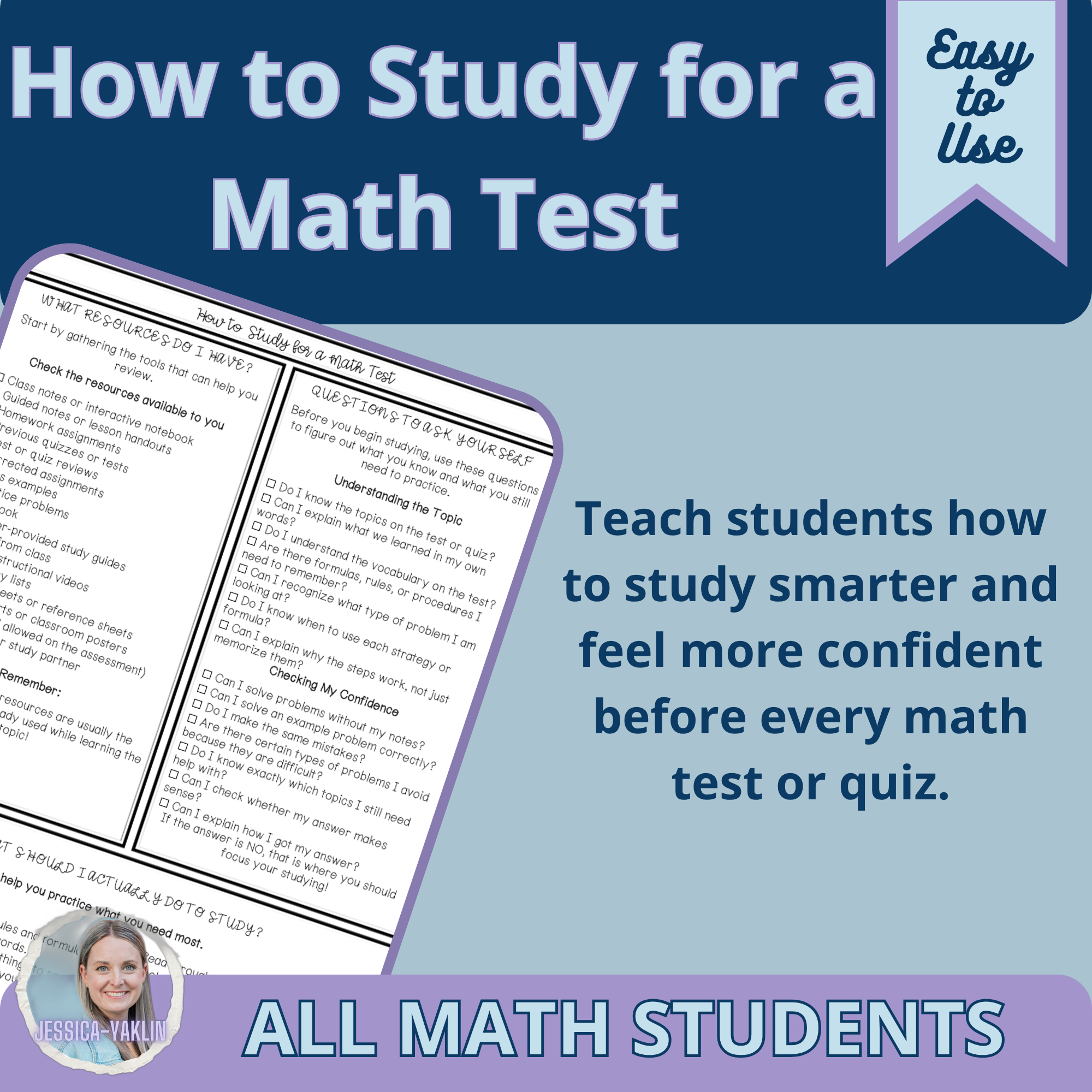
Help students study smarter and feel more confident before math tests and quizzes with Study Smart: A Student’s Guide to Studying for Math Tests & Quizzes. This student-friendly resource teaches middle and high school students how to study for math instead of simply telling them to “go study.” With helpful checklists, reflection questions, and practical study strategies, students learn how to identify what they need to review and choose meaningful ways to prepare for an assessment.
Many students do not know where to begin when preparing for a math test. They may reread their notes, look over a few problems, and hope they remember everything. This resource gives students a clear plan for turning “I don’t know how to study” into actionable steps they can use independently.
Students learn how to identify helpful resources, evaluate their understanding, practice missed problems, learn from mistakes, explain their mathematical thinking, and create a personalized study plan.
What’s Included
Study Resources Checklist to help students identify the notes, assignments, videos, practice problems, and other tools available to help them prepare
Guiding Questions and Reflection Prompts that help students identify what they understand and where they need additional practice
Math Study Strategies Checklist with practical ways students can actively prepare for a test or quiz
Mistake Reflection Prompts to help students identify why they missed a problem and learn how to correct their mistakes
Practice and Review Ideas including reviewing notes, reworking missed problems, practicing without notes, and checking answers
Explain Your Thinking Activities that encourage students to write steps, teach someone else, explain their reasoning, and create their own examples
Personal Study Plan to help students identify topics they feel confident about, topics they need to practice, and their next steps
Student-friendly language designed for middle and high school math students
Learning Objectives
Students will:
Identify helpful resources for studying for math tests and quizzes
Reflect on what they understand and identify areas where they need additional practice
Use effective strategies to review math concepts
Learn from mistakes and correct misconceptions
Practice explaining mathematical thinking and problem-solving strategies
Develop independence and confidence when preparing for assessments
Create a personalized plan for studying more effectively
How to Use This Resource
This guide works beautifully as part of your classroom routines, especially:
Before a math test or quiz
During test review days
At the beginning of the school year when establishing study habits
Before benchmark or standardized testing
During intervention or small-group instruction
As a reflection tool after quizzes and tests
For students who need extra support developing independent study skills
Introduce the guide before an upcoming assessment and model how students can use it to identify what they need to study. Encourage students to gather their resources, answer the reflection questions, and choose study strategies that match their individual needs.
Students can return to this resource throughout the year whenever they are preparing for a math test or quiz.
The Pedagogy: Why It Works
Students are often told to “study for the test,” but many students have never been explicitly taught how to study for math. Effective math studying requires more than rereading notes or looking over completed examples—it requires students to actively practice, identify misconceptions, correct mistakes, and explain their thinking.
This resource breaks the studying process into simple, actionable steps students can immediately apply. By helping students identify what they know, recognize what they still need to learn, and choose purposeful strategies for practicing, students become more independent and confident learners.
Instead of wondering, “How am I supposed to study for this?”, students will have a clear plan for reviewing, practicing, reflecting, and preparing for success.
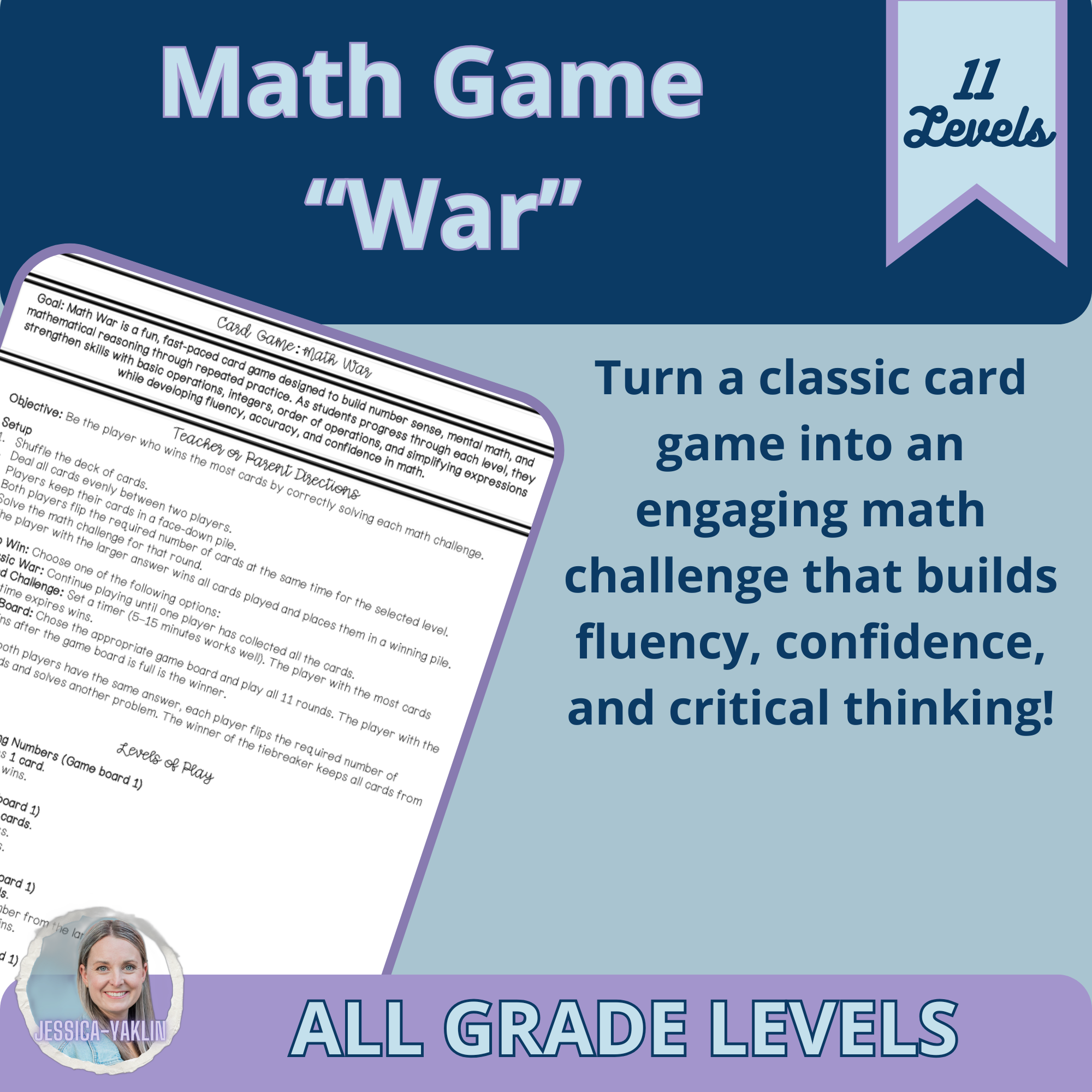
Turn an ordinary deck of cards into an exciting, hands-on math game with Math War! This engaging resource transforms the classic game of War into 11 differentiated levels of math practice that build fluency, number sense, and mathematical reasoning. As students advance through the levels, they practice addition, subtraction, multiplication, integer operations, order of operations, and simplifying expressions while developing confidence through repeated play.
Math War blends friendly competition with meaningful skill practice, making it easy for students to stay engaged while reinforcing essential math concepts. Beginning with simple number comparisons and progressing to simplifying multi-step expressions, this game naturally differentiates instruction so students can practice at their own level. Using only a standard deck of playing cards, students build computational fluency through repeated, low-stress practice that feels more like a game than a worksheet.
This resource is flexible enough to use during math centers, partner work, intervention groups, tutoring sessions, homeschool lessons, early finisher activities, or family game nights. Choose from a classic game where students play until one person collects all the cards, a timed challenge, or structured game boards that provide 11 rounds of focused practice.
This print-and-go resource requires minimal preparation while providing endless opportunities for students to practice essential math skills throughout the year.
What's Included
Teacher/Parent instruction page with setup, game rules, and multiple ways to play
Student-friendly directions
11 differentiated levels of Math War
5 reusable game boards for recording rounds and simplifying expressions
Three ways to play:
Classic War
Timed Challenge
11-Round Game Board Challenge
Uses a standard deck of playing cards—no special materials required
Learning Objectives
Students will:
Build number sense by comparing values and determining the greater number.
Develop fluency with addition, subtraction, and multiplication facts.
Apply integer rules when comparing, adding, subtracting, and multiplying positive and negative numbers.
Simplify numerical expressions using the correct order of operations.
Strengthen mental math, mathematical reasoning, and computational accuracy.
Build confidence through repeated, game-based practice.
How to Use This Resource
Choose the level that best matches your students' current skills, shuffle a standard deck of cards, and deal the cards evenly between two players. Students flip the required number of cards, complete the math challenge for that level, and compare answers. The player with the greater value wins the round and collects the cards. Play until one player has all the cards, set a timer for a quick practice session, or use one of the included game boards for an 11-round challenge. As students become more confident, simply move to the next level to increase the mathematical challenge.
The Pedagogy: Why It Works
Math War combines the excitement of a familiar card game with purposeful mathematical practice. The game encourages repeated computation in a low-pressure environment where students receive immediate feedback by comparing answers with a partner. The progression from basic number comparisons to multi-step expressions provides built-in scaffolding that supports differentiation and long-term skill development. Because students are motivated by friendly competition, they naturally complete far more practice problems than they would with a traditional worksheet, helping improve fluency, accuracy, mental math, and confidence with essential math concepts.
Geometry Resources
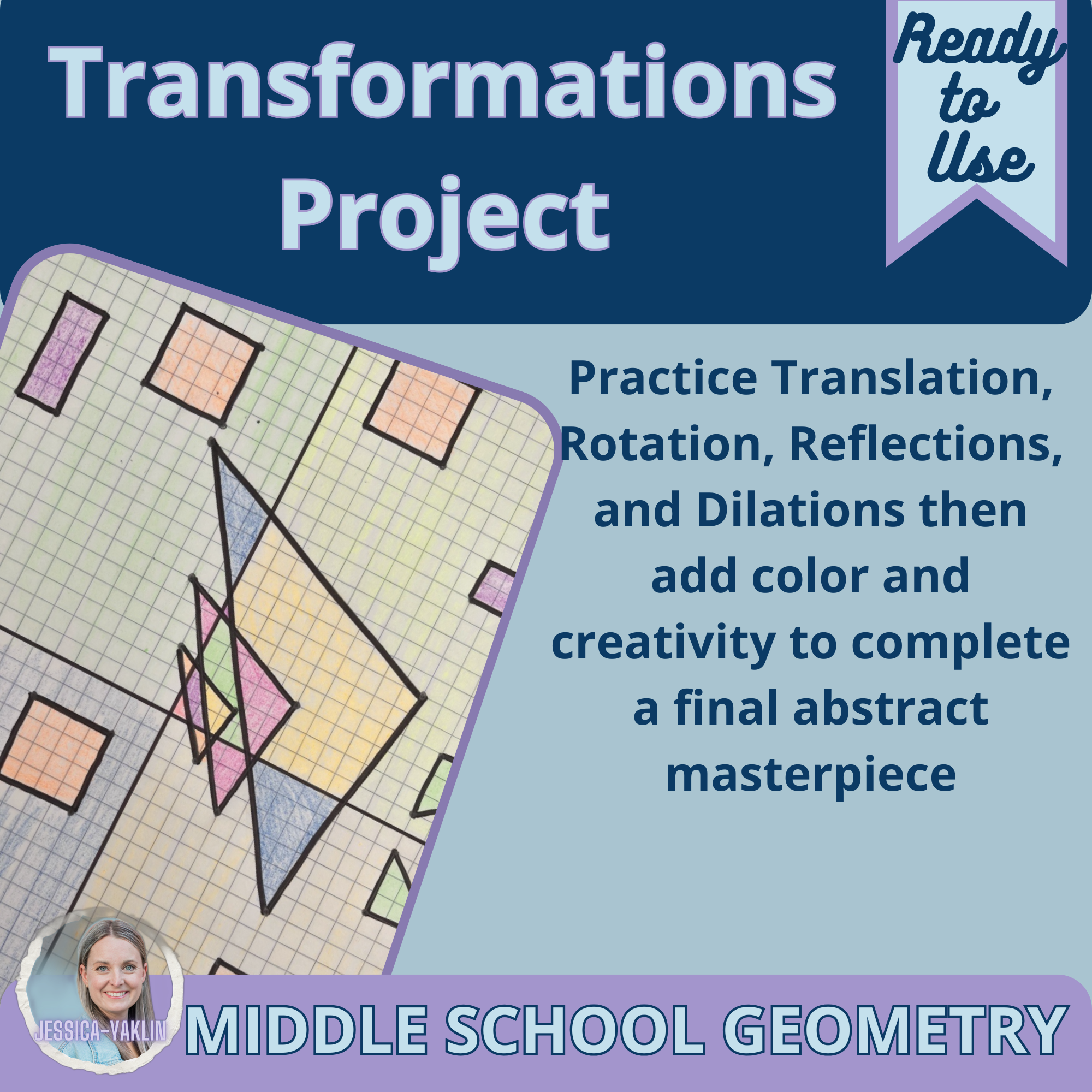
Make geometry meaningful and creative with this Transformations on the Coordinate Plane Project. Students design their own abstract art on a coordinate plane while applying translations, reflections, rotations, and dilations. By following transformation rules and graphing each image, students turn coordinate geometry into a vibrant, visual experience that deepens conceptual understanding.
This Transformations Art Project blends mathematical reasoning with hands‑on creativity. Students begin by constructing four required pre‑image shapes directly from the project instructions. As they progress through each step, they apply transformation rules such as (x,y)→(−x,y) and (x,y)→(0.5x,0.5y) to generate images and record ordered pairs. Each transformation adds another layer to their abstract design, resulting in a colorful final product that showcases both precision and artistry.
Students stay highly engaged because they can see the math take shape. The project requires careful graphing, accurate rule application, and thoughtful reflection—reinforced by built‑in questions. These checkpoints strengthen reasoning and help students articulate how transformations affect figures on the coordinate plane.
This resource is fully print‑and‑go, making it ideal for busy classrooms, homeschool settings, or low‑prep instructional days.
What’s Included
Step‑by‑step student directions for all five project components
Printable graphing pages and transformation tables
Structured tasks for translations, reflections, rotations, and dilations
Built‑in comprehension questions for deeper reasoning
A detailed grading rubric covering accuracy, neatness, and final presentation
Clear requirements for all pre‑images and transformed images
Learning Objectives
Students will:
Plot and construct geometric figures on a coordinate plane
Apply translations, reflections, rotations, and dilations using formal rules
Fill in ordered‑pair tables to track pre‑images and images
Analyze how transformations affect position, orientation, and size
Use mathematical vocabulary to explain their reasoning
Synthesize their work into a polished abstract art design
How to Use This Resource
This project works beautifully as a multi‑day activity, review lesson, or performance assessment.
Students begin by graphing four pre‑image shapes. Next, they complete each transformation task—writing rules, filling in tables, answering conceptual questions, and graphing the resulting images. Finally, they color and refine their abstract art piece, creating a display‑ready final product.
Perfect for:
End‑of‑unit assessments
Geometry or transformations review
Math‑and‑art cross‑curricular lessons
Enrichment or early‑finisher projects
Sub plans or low‑prep instructional days
The Pedagogy: Why It Works
Transformations become far more meaningful when students apply them rather than memorize rules. This project requires students to reason about how each transformation changes a figure’s location, orientation, and size. Because the artwork emerges gradually—shape by shape—students stay motivated and invested in accuracy.
The combination of graphing, rule writing, and reflection questions supports multiple learning modalities. Students build procedural fluency, strengthen spatial reasoning, and develop a conceptual understanding of transformations. The final abstract art piece provides a sense of ownership and pride while reinforcing essential geometry skills.
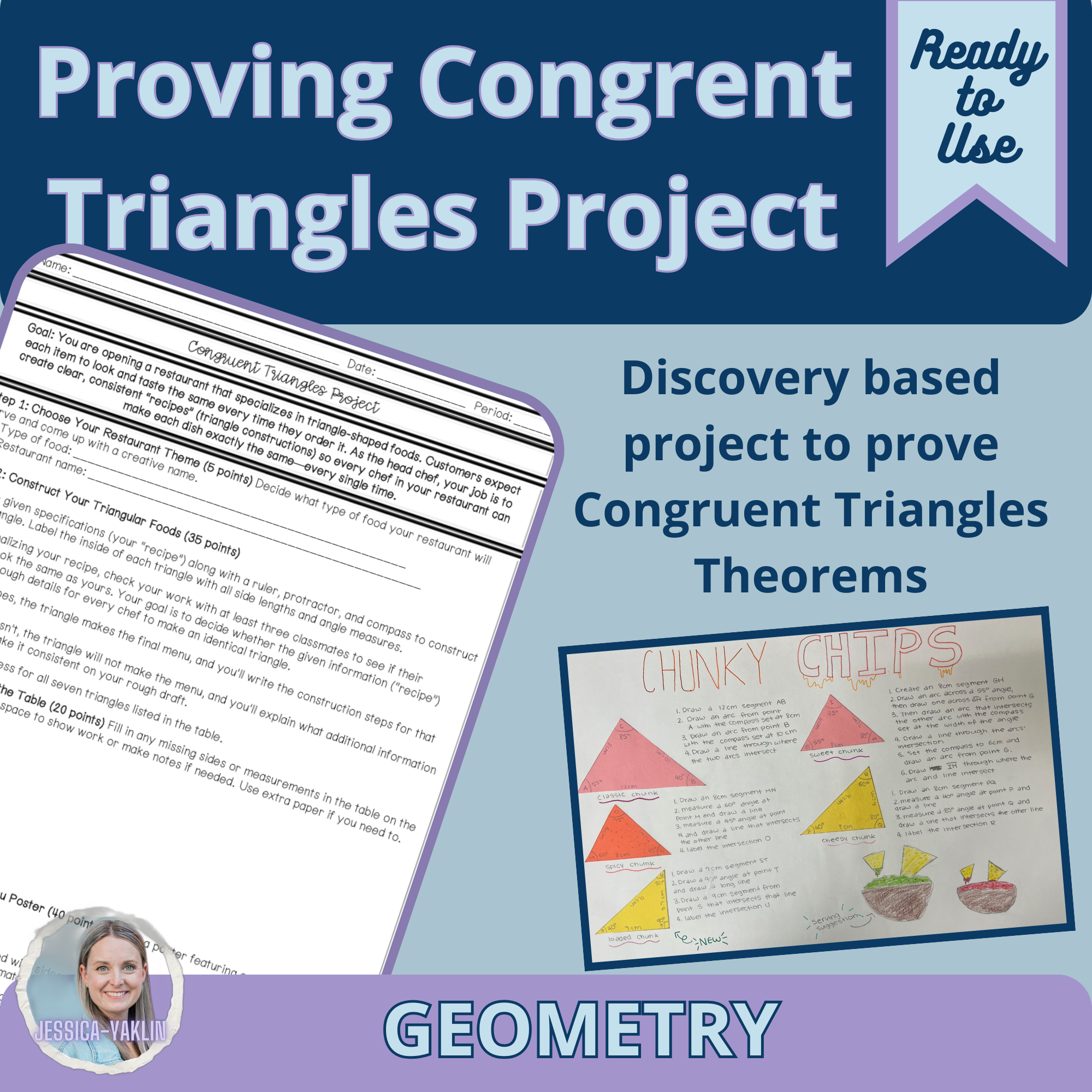
Project! Students step into the role of “chefs” designing triangle‑shaped menu items as they explore and apply triangle congruence criteria. Through hands‑on constructions, measurement, and reasoning, students learn how different combinations of sides and angles determine whether a triangle can be uniquely created—just like a reliable recipe in a professional kitchen.
This Congruent Triangles Project blends geometric reasoning with creativity and problem solving. Students construct triangles using tools such as a ruler, protractor, and compass; analyze whether given information guarantees congruence; and determine which “recipes” are consistent enough to make the final restaurant menu. As they complete each construction, students build a deeper understanding of SSS, SAS, ASA, AAS, HL, and the ambiguous SSA case.
Students stay highly engaged because they can see the geometry take shape. Each construction becomes part of their themed restaurant menu, encouraging precision, collaboration, and thoughtful reflection. This project works beautifully as an end‑of‑unit assessment, enrichment task, or creative review lesson.
This resource is print‑and‑go and easy to implement, making it ideal for busy classrooms or homeschool settings.
What’s Included
Clear step‑by‑step student directions and project overview
Seven triangle “recipes” using different congruence criteria
Rough draft pages for measurements, labeling, and peer review
A final menu poster task with guidelines and point breakdown
Built‑in opportunities for collaboration, critique, and reflection
Learning Objectives
Students will:
Apply triangle congruence criteria (SSS, SAS, ASA, AAS, HL, and SSA)
Construct triangles accurately using a ruler, protractor, and compass
Determine whether given information is sufficient to create a unique triangle
Label and measure angles and sides with precision
Communicate geometric reasoning visually and in writing
Synthesize mathematical work into a creative, real‑world themed project
How to Use This Resource
This project works well as a multi‑day geometry activity or end‑of‑unit assessment. Students begin by constructing triangles from given “recipes” and checking whether their classmates produce identical results. Next, they analyze which sets of information guarantee congruence and revise any inconsistent recipes. Finally, students design a polished restaurant menu poster featuring their completed triangles, names, and construction steps.
The Pedagogy: Why It Works
Students learn geometry best when they can connect abstract concepts to hands‑on, visual experiences. This project transforms triangle congruence into a meaningful, creative task where students must reason carefully about which measurements determine a unique triangle. The restaurant theme adds motivation and purpose, while the construction process reinforces precision, tool use, and geometric reasoning. Students take pride in their final menu posters and gain a deeper understanding of congruence through authentic mathematical practice.
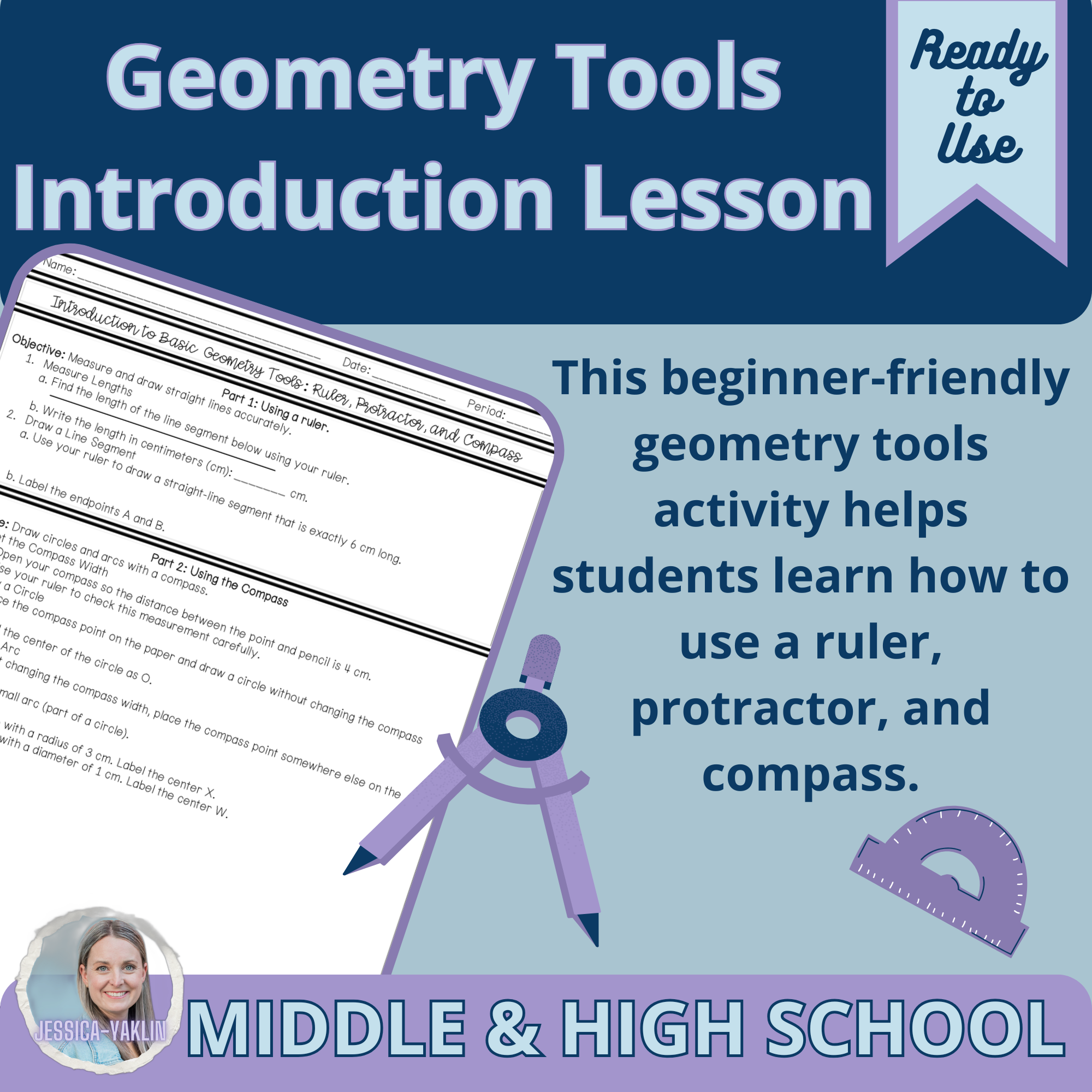
Build confidence with geometry and give students a strong foundation in using essential math tools with this Geometry Tools Practice Activity. This hands-on resource teaches students how to accurately use a ruler, protractor, and compass through clear directions, guided practice, and engaging geometric constructions. Whether you use it to introduce geometry tools, review measurement skills, or reinforce precision throughout your geometry unit, students will develop confidence while mastering the tools they'll use all year long.
Students measure and draw line segments, construct and measure angles, create circles and arcs with a compass, and complete a geometric construction challenge. As they progress through each activity, they build accuracy, mathematical reasoning, and confidence with every new skill.
This resource is flexible enough for a variety of classroom settings—use it as an introductory lesson, guided practice, math stations, independent work, or a beginning-of-year geometry review.
What's Included
Guided practice measuring and drawing line segments with a ruler
Step-by-step practice measuring and constructing angles using a protractor
Compass activities for drawing circles and arcs
Geometric construction challenge: construct an equilateral triangle
Reflection questions to reinforce understanding of each geometry tool
Clear student-friendly directions for easy implementation
Learning Benefits
Students will:
Accurately measure and draw line segments using a ruler
Measure and construct angles with confidence using a protractor
Draw circles and arcs using a compass
Apply multiple geometry tools to complete a geometric construction
Strengthen precision, mathematical reasoning, and attention to detail
Build confidence using the tools required throughout middle school and high school geometry
Why It Works
Many students struggle with geometry because they have limited experience using the tools required to explore geometric concepts. This activity builds confidence by introducing one tool at a time through structured, guided practice before asking students to apply multiple skills together.
As students move from measuring to constructing, they develop both procedural fluency and conceptual understanding. The hands-on activities transform abstract geometry into meaningful learning experiences while reinforcing the importance of precision and mathematical accuracy.
The culminating equilateral triangle construction encourages students to synthesize everything they've learned, helping them retain these foundational skills for future geometry topics.
Classroom Use Ideas
Beginning-of-unit geometry lesson
Introducing rulers, protractors, and compasses
Back-to-school geometry review
Guided math instruction
Independent practice
Math station
Small-group intervention
Geometry review before assessments
Standards Alignment
TEKS
MA.7.5.A: Investigate and apply geometric relationships using appropriate tools.
MA.7.5.C: Use geometric tools to construct figures and solve problems involving geometric relationships.
CCSS
CCSS.MATH.CONTENT.7.G.A.2: Draw geometric shapes with given conditions and solve problems involving scale drawings and constructions.
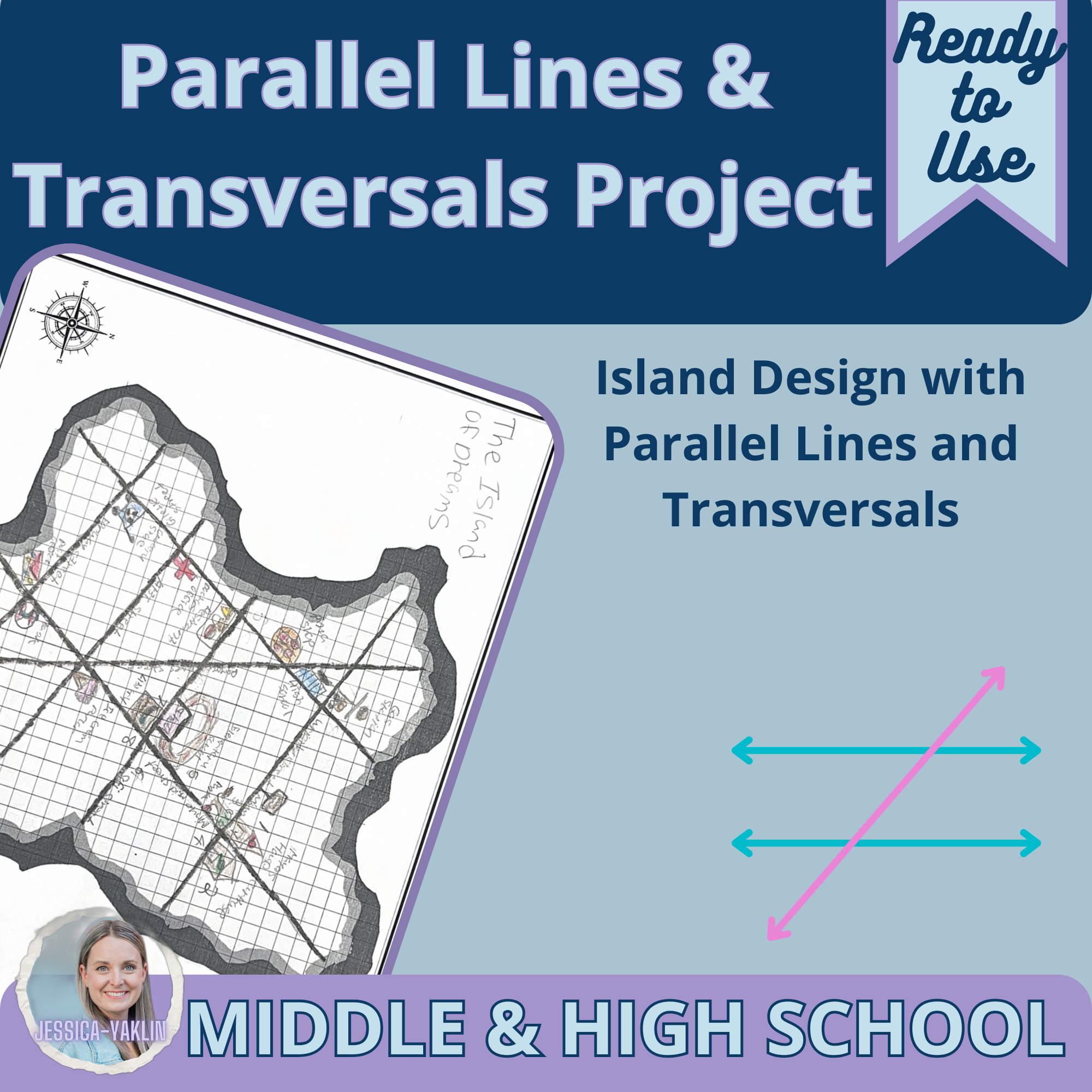
Bring parallel lines and transversals to life with this Private Island Parallel Lines and Transversals Project. Students become civil engineers as they design their own themed island, create a network of parallel streets and transversal roads, and strategically place buildings based on angle relationships. By connecting geometry vocabulary to a creative real-world scenario, students develop a deeper understanding of angle pair relationships while producing a colorful, one-of-a-kind island map.
This Parallel Lines and Transversals Project blends mathematical reasoning with hands-on creativity. Students begin by planning a private island complete with four parallel streets and two transversal roads. As they build their map, they place landmarks and businesses according to geometric relationships such as corresponding angles, alternate interior angles, alternate exterior angles, vertical angles, supplementary angles, and linear pairs. The project concludes with a partner challenge where students create and solve their own angle puzzle using algebraic reasoning and transversal vocabulary.
Students stay highly engaged because they are making meaningful decisions throughout the project rather than simply completing a worksheet. Designing a themed island, naming streets and businesses, and creating a peer challenge encourages ownership while reinforcing essential geometry concepts. Built-in creativity and problem solving make this an activity students genuinely enjoy.
This resource is fully print-and-go, making it perfect for busy classrooms, homeschool settings, or low-prep instructional days.
What's Included
Creative island design project with engaging student scenario
Step-by-step student directions
Printable island map templates
Building key for labeling landmarks and businesses
Geometry placement tasks using angle relationships
Student-created partner challenge for solving angle measures
Detailed grading rubric for easy assessment
Learning Objectives
Students will:
Identify and apply angle relationships formed by parallel lines and transversals.
Distinguish between corresponding, alternate interior, alternate exterior, vertical, supplementary, and linear pair angles.
Use mathematical vocabulary in a meaningful context.
Create and label a geometric map using precise mathematical relationships.
Construct and solve angle measurement problems using algebraic reasoning.
Communicate mathematical thinking through a creative design project.
How to Use This Resource
This project works beautifully as a multi-day activity, end-of-unit assessment, or engaging review lesson.
Students begin by designing a themed private island and drawing four parallel streets with two transversal roads. They then place buildings at specific angle relationships, label their map, and complete a visual key. Finally, students create their own angle-measurement challenge for a classmate by writing clues using algebraic expressions and transversal vocabulary before solving the puzzle themselves.
Perfect for:
End-of-unit assessments
Parallel lines and transversals review
Geometry enrichment activities
Early finisher projects
Math centers
Homeschool lessons
Sub plans or low-prep instructional days
The Pedagogy: Why It Works
Students understand geometry more deeply when they apply concepts in meaningful contexts instead of memorizing vocabulary. This project requires students to analyze angle relationships, justify their placement decisions, and communicate mathematical reasoning throughout the activity. Designing their own island transforms abstract geometry concepts into an engaging visual experience.
The addition of the peer-created angle challenge extends learning beyond identification by requiring students to think like both the teacher and the learner. Creating clues, using algebraic reasoning, and solving for unknown angles strengthens conceptual understanding while promoting higher-order thinking. The final island map provides students with a sense of ownership and accomplishment while reinforcing essential geometry standards.
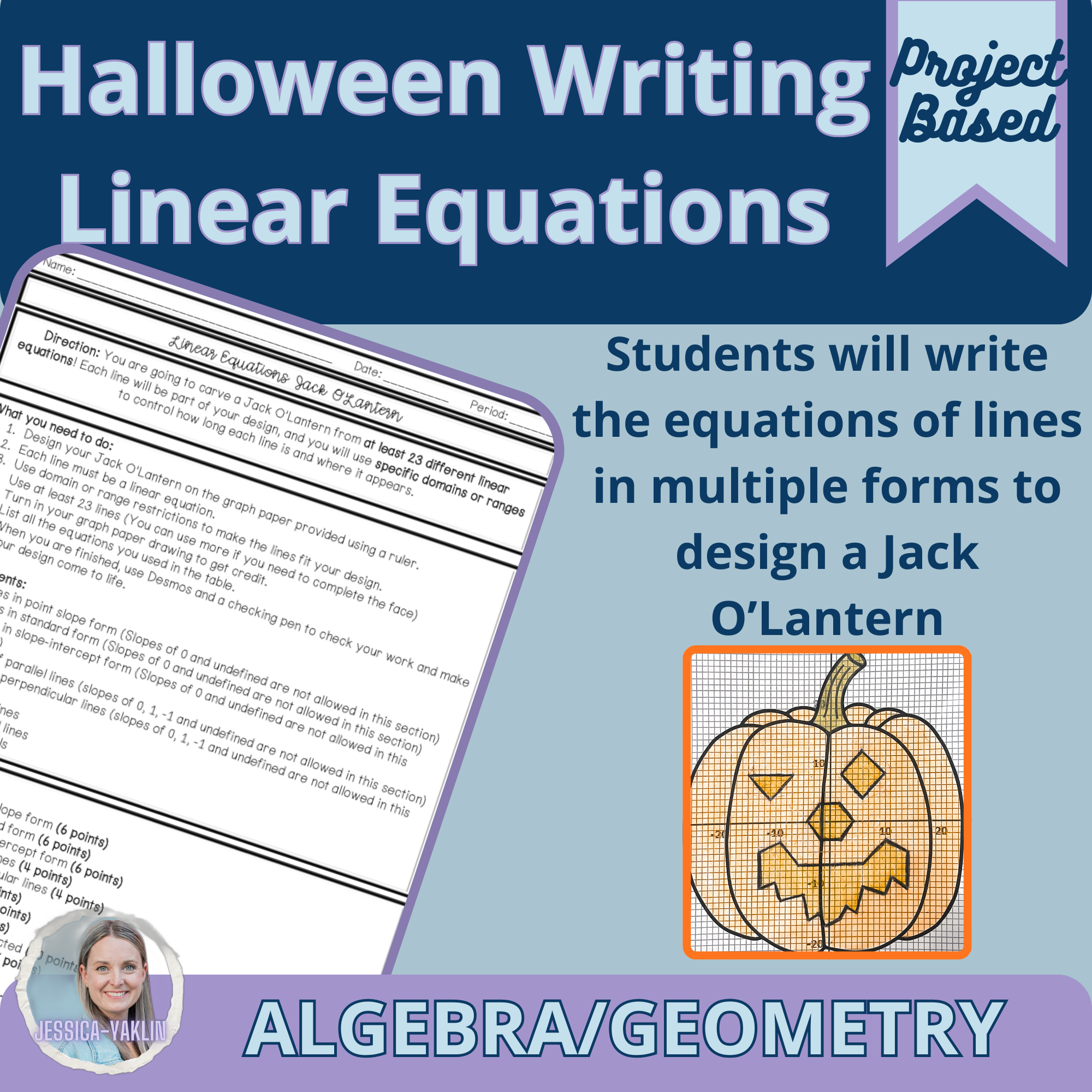
Bring linear equations to life with this Halloween Jack-O’-Lantern Linear Equations Project! Students transform equations into a creative, spooky design as they graph lines and use their understanding of slope, equation forms, and linear relationships to build their own Jack-O’-Lantern masterpiece. By connecting algebraic equations to a visual design, students get meaningful practice with linear equations while creating a fun Halloween-themed project they’ll be proud to display.
This Halloween Linear Equations Project blends algebraic reasoning with hands-on creativity. Students write and graph linear equations in slope-intercept form, point-slope form, and standard form while incorporating parallel and perpendicular lines, domain and range restrictions, and transversals into their designs. An equation table organizer helps students keep track of their work, while reflection and concept questions encourage them to think beyond simply graphing each equation.
Students stay engaged because they are creating something rather than simply completing a traditional worksheet. Each equation becomes part of a larger visual design, giving students a reason to pay attention to accuracy and think carefully about how algebraic representations translate to a coordinate plane. The finished Jack-O’-Lanterns make a fun addition to a Halloween bulletin board or classroom display.
This resource is low-prep and easy to implement, making it perfect for a Halloween review activity, end-of-unit project, enrichment opportunity, or engaging lesson during the weeks leading up to Halloween.
What's Included
Creative Halloween Jack-O’-Lantern graphing project
Two different Jack-O’-Lantern templates
Step-by-step student directions
Equation table organizer for organizing and checking equations
Detailed project rubric for easy assessment
10 reflection and concept questions
Teacher instructions for implementation
Opportunities for students to graph by hand or digitally using Desmos
Learning Objectives
Students will:
Write and graph linear equations in slope-intercept, point-slope, and standard form.
Identify and apply relationships between parallel and perpendicular lines.
Use domain and range restrictions to create specific line segments.
Apply transversal concepts on a coordinate plane.
Connect equations, tables, and graphs to a visual representation.
Analyze and reflect on their mathematical thinking.
Communicate their understanding of linear equations through a creative project.
How to Use This Resource
This project works beautifully as a multi-day activity, end-of-unit assessment, or engaging Halloween review.
Students begin by reviewing the project requirements and organizing their equations using the equation table. They then graph each equation on their Jack-O’-Lantern template, paying close attention to slope, intercepts, equation form, restrictions, and line relationships. Students can complete their designs on paper or use Desmos to support the graphing process.
Once their Jack-O’-Lantern is complete, students answer the reflection and concept questions to explain their mathematical thinking. Finished projects can then be displayed around the classroom or on a Halloween bulletin board.
Perfect for:
Algebra 1 linear equations review
Slope and equation forms practice
End-of-unit projects
Halloween math activities
Graphing linear equations review
Geometry students reviewing algebra skills
Early finisher enrichment
Substitute plans or low-prep instructional days
Math bulletin board displays
Engaging pre-holiday classroom activities
The Pedagogy: Why It Works
Students often understand linear equations more deeply when they can see how equations, graphs, and visual representations connect. This project moves students beyond simply solving or graphing equations by requiring them to use mathematical constraints to create a specific design.
As students translate equations into line segments, analyze parallel and perpendicular relationships, and apply domain and range restrictions, they are constantly checking whether their algebraic work produces the intended graphical result. This encourages precision, problem solving, and mathematical reasoning.
The creative component gives students ownership of their work while making abstract algebra concepts more memorable. The reflection questions provide an opportunity for students to explain their reasoning and demonstrate conceptual understanding—not just produce a finished picture.
The result is a Halloween activity that feels fun and creative while still providing meaningful Algebra 1 practice with linear equations and graphing.
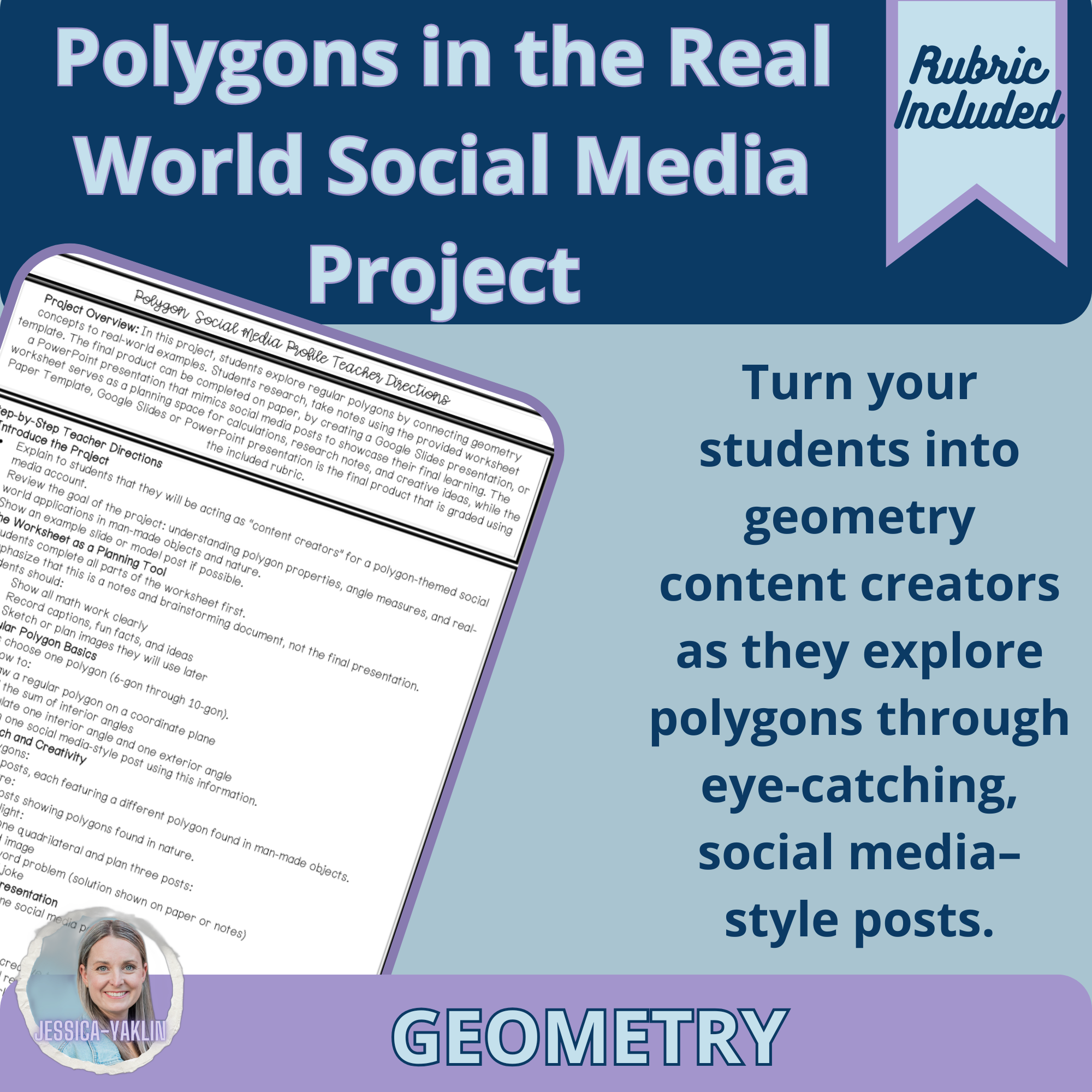
Engage your students with a creative and meaningful geometry project that connects math to the real world. This Polygons and Quadrilaterals Social Media Project helps students explore polygon properties, calculate interior and exterior angles, and identify polygons in both nature and everyday objects. Students become “content creators” as they design social-media-style posts that showcase their understanding of geometry concepts.
This project blends mathematical reasoning, creativity, and digital design into one highly engaging assignment. Students research polygons, perform angle calculations, and create visual posts with captions, images, and fun facts. The activity works well as a multi-day project, enrichment assignment, or end-of-unit assessment.
Bring geometry to life with this Polygons Social Media Math Project! Students explore regular polygons, investigate quadrilaterals, and analyze polygon examples in architecture, art, and nature. Each task encourages students to connect geometry concepts to the world around them while presenting their ideas in a format that feels familiar and engaging.
This resource works in both digital and printable classrooms, making it flexible for many learning environments. Students can complete their final product using Google Slides, PowerPoint, or printed templates.
What's Included
Clear teacher directions with step-by-step project guidance
Student planning worksheet for calculations, sketches, and notes
Part 1: Regular polygon investigation with coordinate plane drawing and angle calculations
Part 2: Six social-media-style posts featuring polygons found in man-made objects
Part 3: Three posts highlighting polygons found in nature
Part 4: Quadrilateral spotlight with facts, a real-world word problem, and a math joke
Detailed grading rubric for accuracy, creativity, and completion
Instructions for converting pages to Google Slides or PowerPoint backgrounds for digital learning
Learning Objectives
Students will:
Identify and classify polygons and quadrilaterals
Calculate interior and exterior angle measures of regular polygons
Apply polygon knowledge to real-world objects and patterns
Create visual explanations of geometry concepts
Develop communication and presentation skills through creative design
How to Use This Resource
This project works well as a multi-day geometry assignment or end-of-unit project. Students begin by choosing a regular polygon and calculating angle measures. Next, they research polygons found in man-made objects such as buildings or signs. Students then explore polygons in nature, identifying geometric patterns in plants and animals. Finally, students complete a quadrilateral spotlight, including key properties, a word problem, and a math joke. Each completed section becomes a social-media-style post in the final project. Students can present their work digitally or create a printed display.
Perfect For…
• 6th Grade, 7th Grade, and 8th Grade Math
• Geometry or Geometry Foundations courses
• Polygon and quadrilateral units
• End-of-unit projects or performance assessments
• Math centers or enrichment assignments
• Digital classrooms using Google Slides or PowerPoint
• Creative students who enjoy visual learning
The Pedagogy: Why It Works
This project combines conceptual understanding with creativity. Students first complete the math work on a planning worksheet. Then they transform their learning into visual posts that explain the concept.
The structure encourages mathematical accuracy before design. Students must show calculations and reasoning before creating their final posts. This process strengthens problem solving and critical thinking.
The real-world connections also increase engagement. Students begin to notice polygons in architecture, design, and nature. These connections make geometry feel relevant and meaningful.
Algebra Resources
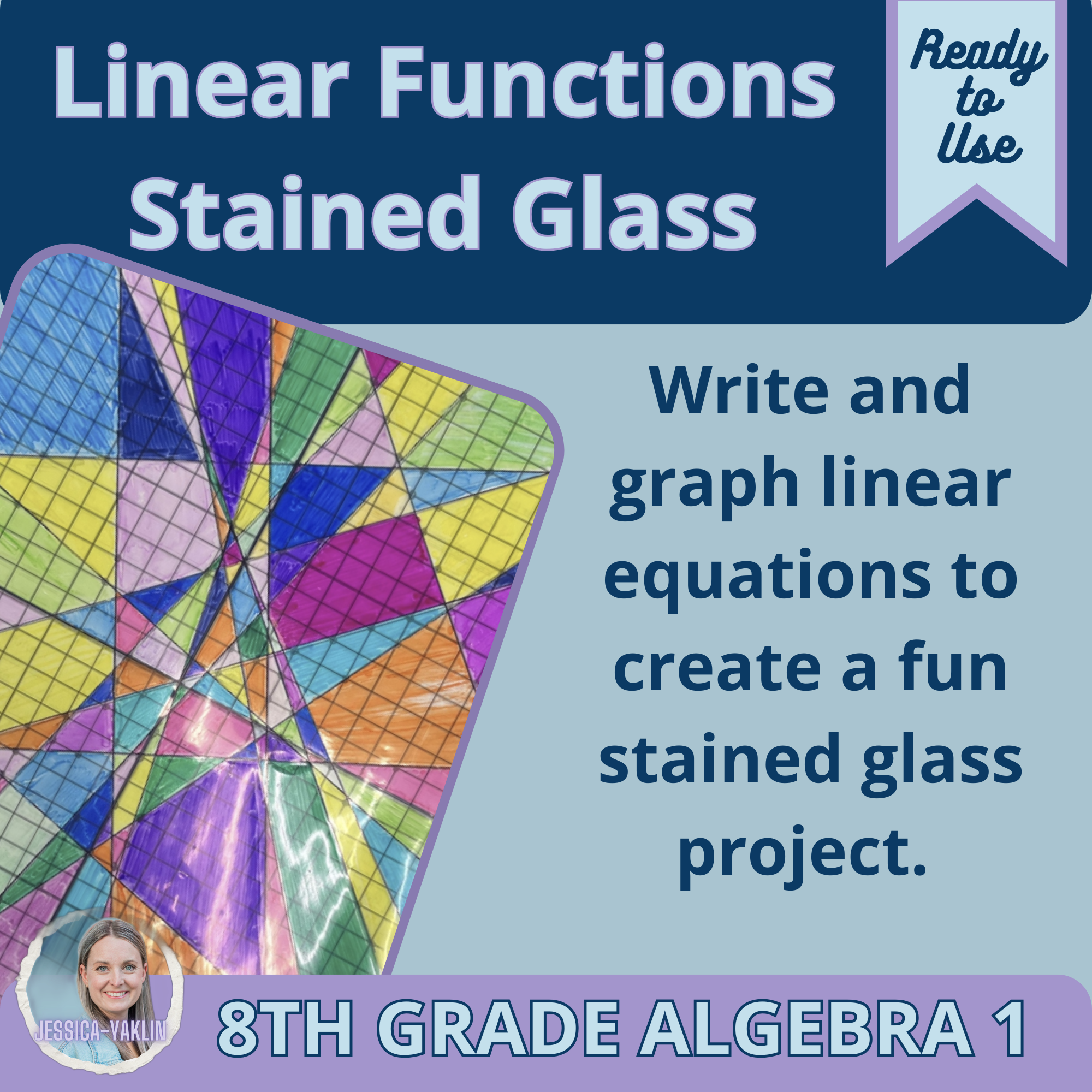
Turn algebra into a creative masterpiece with this Linear Functions Stained Glass Math Project. This engaging activity helps students practice graphing and analyzing linear functions while creating a colorful stained-glass style design. Students explore key features of linear equations while transforming algebra concepts into visual art on the coordinate plane.
This Linear Functions Stained Glass Project blends algebra skills with creativity and problem solving. Students graph linear equations, analyze slope and intercepts, and work with different equation forms. As they complete each graph, a beautiful stained-glass design begins to appear. The final product becomes a vibrant math display that celebrates both accuracy and creativity.
Students stay highly engaged because they can see the math come to life. Each line contributes to the final design, encouraging careful graphing and attention to detail. The project works well as an end-of-unit assessment, enrichment activity, or creative review lesson.
This resource is print-and-go and easy to implement, making it ideal for busy classrooms or homeschool parent.
What’s Included
• Clear step-by-step student directions for completing the project
• Printable worksheet pages for converting and planning
• Linear equation tasks requiring students to analyze and graph lines
• A student-friendly grading rubric for easy assessment
Learning Objectives
Students will:
• Identify key features of linear functions including slope and intercepts
• Convert between slope-intercept, point-slope, and standard form equations
• Graph linear equations accurately on a coordinate plane
• Write equations of lines parallel and perpendicular to a given line
• Analyze transformations of linear functions
• Demonstrate understanding through a creative visual project
How to Use This Resource
This project works well as a multi-day algebra activity or unit assessment. Students begin by analyzing and writing equations of linear functions. Next, they graph the equations carefully on the coordinate plane. Each graph contributes to the stained-glass pattern. As students complete the graphs, the design becomes visible. Students can then color their finished designs to create a stained-glass effect.
The Pedagogy: Why It Works
Students learn algebra best when they can visualize mathematical relationships. This project connects abstract algebra concepts to a visual design that grows as students graph each line. The process encourages precision and careful reasoning. Students must correctly analyze each equation before graphing it. This reinforces understanding of slope, intercepts, and equation forms. Adding the artistic element increases engagement and motivation. Students take pride in their final stained-glass designs while mastering important algebra skills.
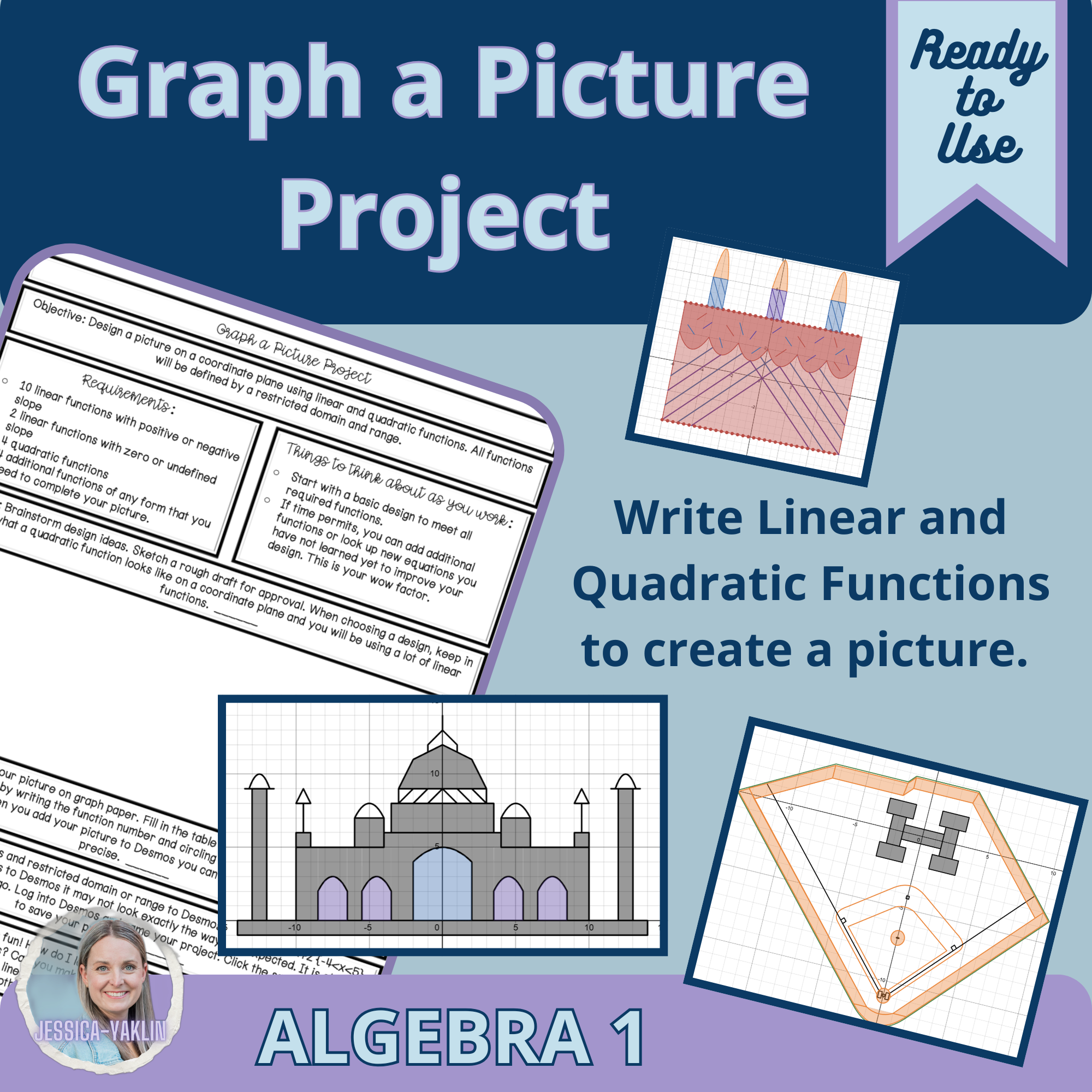
Turn algebra into a creative masterpiece with this Graph a Picture Project, where students design their own coordinate‑plane artwork using linear and quadratic functions. This hands‑on activity transforms abstract math concepts into visual art. Students bring their designs to life by writing equations, estimating domain and range, and transferring their work to Desmos for a polished digital version. With a balance of structure and creativity, this project reinforces algebraic understanding while giving students the freedom to create something uniquely their own.
Why Students Love This Project
As students graph each function, their picture gradually appears—building excitement, ownership, and motivation. The artistic element keeps engagement high, while the math demands precision and conceptual understanding. Students must think critically about how linear and quadratic functions behave, how to restrict domains, and how to combine multiple equations to form a cohesive image.
What’s Included
Step‑by‑step student directions for brainstorming, drafting, and graphing
Planning table for all 20 required functions (linear, quadratic, and student‑choice)
Clear instructions for transferring the project to Desmos
A detailed grading rubric aligned to your original criteria
Skills Students Will Build
Writing and graphing linear functions with positive, negative, zero, and undefined slopes
Graphing quadratic functions and understanding their shape on the coordinate plane
Applying domain and range restrictions to control the appearance of each segment
Using Desmos to refine precision and enhance their final design
Strengthening spatial reasoning, problem‑solving, and mathematical creativity
Learning Objectives
Students will:
Identify and analyze key features of linear and quadratic functions
Write equations in multiple forms and apply them to a real design
Graph functions accurately with restricted domains and ranges
Combine multiple functions to create a cohesive image
Demonstrate conceptual understanding through a creative, visual project
How to Use This Resource
This project works beautifully as:
An end‑of‑unit assessment for linear or quadratic functions
A multi‑day algebra project
A creative review activity
A math‑and‑art crossover lesson
An enrichment or early‑finisher challenge
A technology‑integrated assignment
Perfect For…
Algebra 1 and Algebra 2
8th grade linear & quadratic units
Teachers who want a rigorous but creative assessment
Students who enjoy visual learning and hands‑on math
End‑of‑year projects that feel meaningful and fun
The Pedagogy: Why It Works
Students learn best when they can see the math. This project connects algebraic rules to visual outcomes, helping students internalize how equations behave. By restricting domains and ranges, they gain a deeper understanding of function behavior and precision. The creative component boosts engagement, ownership, and pride—while still requiring strong algebraic reasoning.
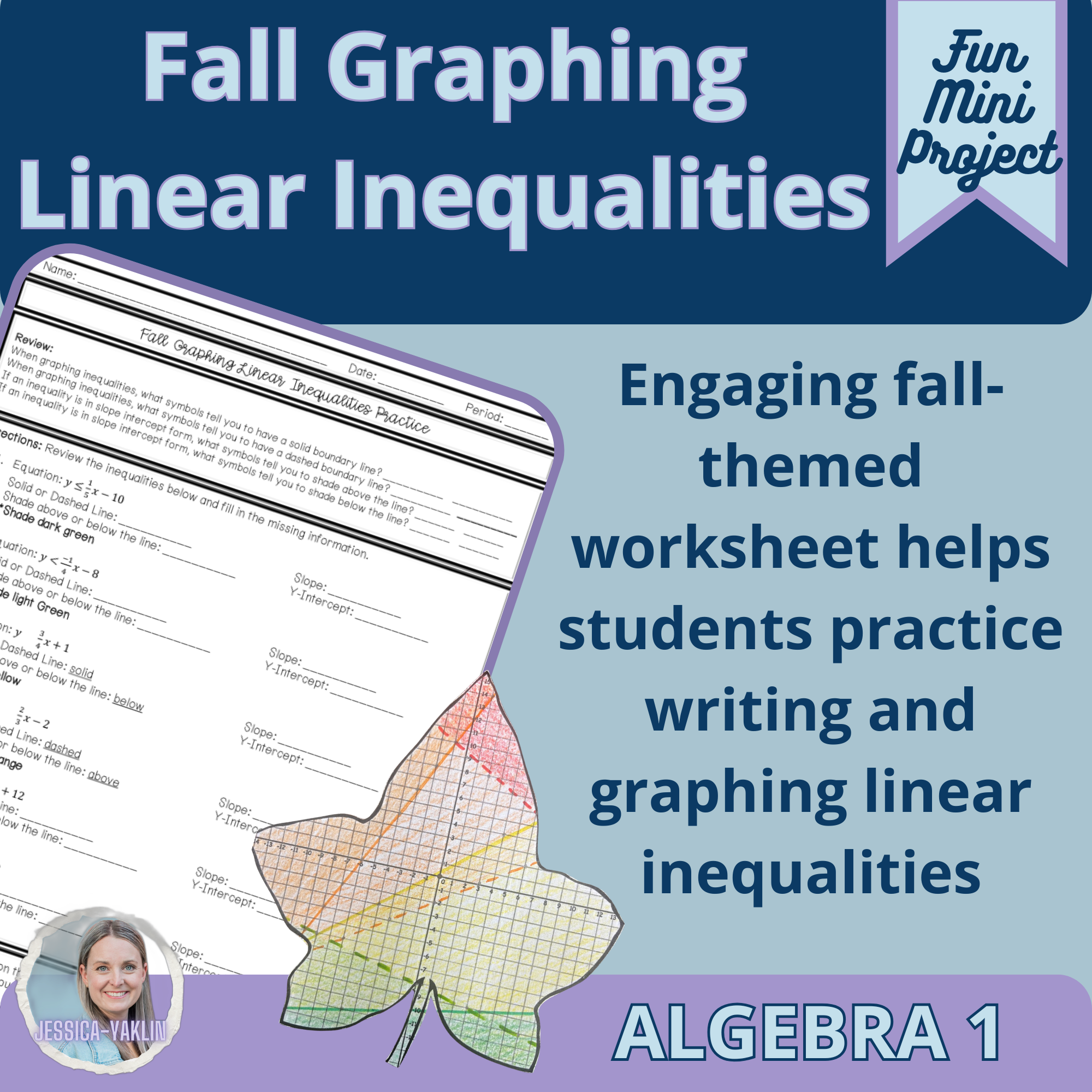
Give your students engaging, seasonal practice with graphing linear inequalities, identifying slope and y-intercept, and determining whether to use a solid or dashed boundary line. This fall-themed activity is perfect for warm-ups, math stations, partner work, review, test prep, or independent practice as students strengthen their understanding of graphing inequalities.
Students will graph six linear inequalities in slope-intercept form, shade the correct solution regions, and follow color-coded directions to create a fun fall-themed coloring page. The finished product makes a great classroom display or festive bulletin board!
What's Included:
6 linear inequalities in slope-intercept form, ready to be graphed!
A dedicated student page for reviewing important graphing inequality rules.
A spacious graphing page where all six inequalities come together to create a fun fall-themed design.
Clear, step-by-step directions that make this activity easy to implement.
A completed coloring page that can be displayed on a fall bulletin board or sent home for students to share.
Learning Objectives
Graph linear inequalities in slope-intercept form.
Identify and interpret the slope and y-intercept.
Determine when to use a solid or dashed boundary line.
Correctly shade the solution region of an inequality.
Connect algebraic representations of inequalities to their graphs on the coordinate plane.
How to Use This Resource:
This activity is a fun, hands-on way to practice graphing linear inequalities.
Students will first analyze each inequality and identify the slope, y-intercept, boundary line, and shading direction.
As students graph and shade all six inequalities, a festive fall coloring page will emerge!
The completed activity can be colored and displayed, making it a wonderful fall bulletin board display or seasonal classroom decoration.
Perfect as a no-prep fall math activity, engaging review lesson, test prep activity, or sub plan.
Perfect For...
Pre-Algebra, 8th Grade Math, and Algebra 1 classrooms.
Teachers looking for engaging fall-themed math activities.
Practicing and reviewing graphing linear inequalities.
Math stations, partner activities, or independent practice.
Creating a festive and educational bulletin board display.
Students who benefit from visual and hands-on learning experiences.
A no-prep printable activity for busy math teachers.
The Pedagogy: Why It Works
This resource combines algebraic thinking with visual learning. Instead of simply graphing one inequality at a time, students see how multiple inequalities and shaded regions work together to create a complete image. This helps students make meaningful connections between slope, y-intercept, boundary lines, and solution regions.
The activity also provides natural scaffolding. Students move from analyzing each inequality to graphing the boundary line, deciding whether it should be solid or dashed, and determining which side to shade. The final coloring component adds a creative and seasonal element that makes practicing an important Algebra skill feel more engaging and memorable.
Bring some fall fun to your math classroom! Add this Fall Graphing Linear Inequalities Activity to your cart and give your students meaningful, hands-on practice with a finished product they'll be proud to display.
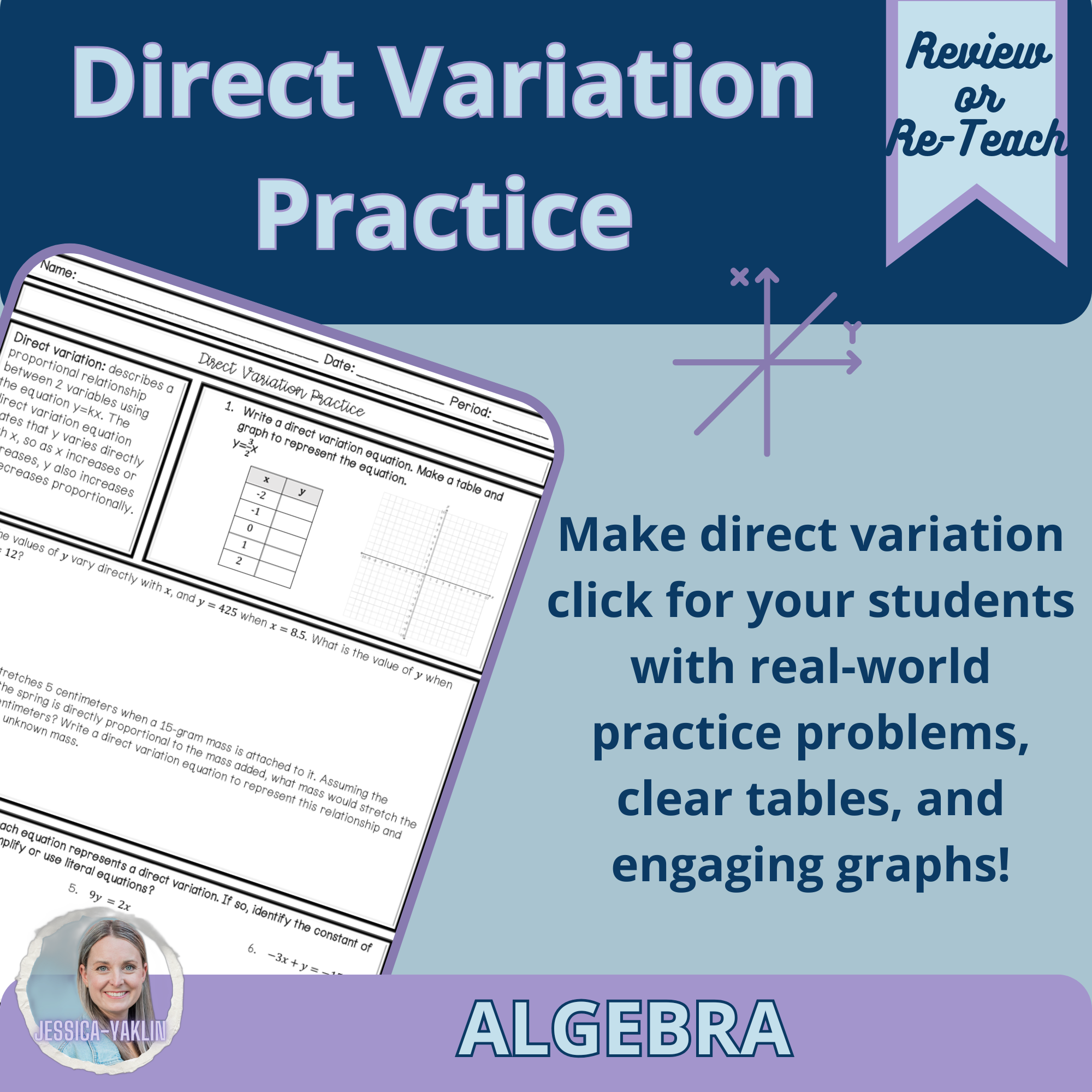
Give your students meaningful, real-world practice with direct variation using this engaging, no-prep math worksheet! This resource helps students build confidence with direct variation equations, tables, graphs, and the constant of variation while making the concept easier to understand and apply.
Students will work through six real-world scenarios and a variety of practice problems as they write and interpret direct variation equations in the form of y = kx. The mix of equations, tables, graphs, and word problems gives students multiple opportunities to recognize and apply direct variation in different representations.
What's Included:
6 real-world direct variation word problems.
Practice writing direct variation equations.
Tables of values to complete and analyze.
Graphing practice for direct variation relationships.
Practice identifying the constant of variation (k) from equations and tables.
Mixed-skill problems that require students to apply direct variation concepts.
Student-friendly practice that works well for independent or collaborative learning.
Learning Objectives
Write equations for direct variation relationships.
Identify the constant of variation.
Determine whether a relationship represents direct variation.
Create and interpret tables of values.
Graph direct variation relationships.
Connect equations, tables, graphs, and real-world situations.
Apply the formula y = kx to solve real-world problems.
How to Use This Resource:
Use this worksheet after introducing direct variation to give students meaningful practice with the concept.
Have students work independently, with a partner, or in small groups.
Use the real-world scenarios to help students connect direct variation to situations outside the math classroom.
Use the equation, table, and graph problems for additional practice or spiral review.
Perfect for classwork, homework, math stations, sub plans, review, or test prep.
Because no preparation is required, simply print and go!
Perfect For...
7th and 8th Grade Math and Algebra 1 classrooms.
Introducing or reviewing direct variation.
Practicing y = kx and the constant of variation.
Connecting multiple representations of linear relationships.
Students who need additional practice interpreting equations, tables, and graphs.
Independent practice, partner work, or math stations.
Homework, early finishers, sub plans, or test preparation.
Teachers looking for a low-prep, real-world math activity.
The Pedagogy: Why It Works
Direct variation can feel abstract when students only work with equations and formulas. This resource gives students multiple ways to interact with the concept so they can recognize the relationship across equations, tables, graphs, and real-world situations.
The real-world word problems help students understand what the constant of variation actually represents rather than simply memorizing how to calculate it. Students also practice moving between different mathematical representations, strengthening their ability to recognize and apply direct variation in unfamiliar situations.
The variety of problems provides natural opportunities for students to practice, reason, and build confidence. Whether you're introducing direct variation for the first time or reviewing before an assessment, this resource gives students focused practice without requiring a complicated setup.
Help your students see that direct variation doesn't have to be confusing! Add this Direct Variation Practice Worksheet to your classroom and give students meaningful practice with equations, tables, graphs, and real-world applications.
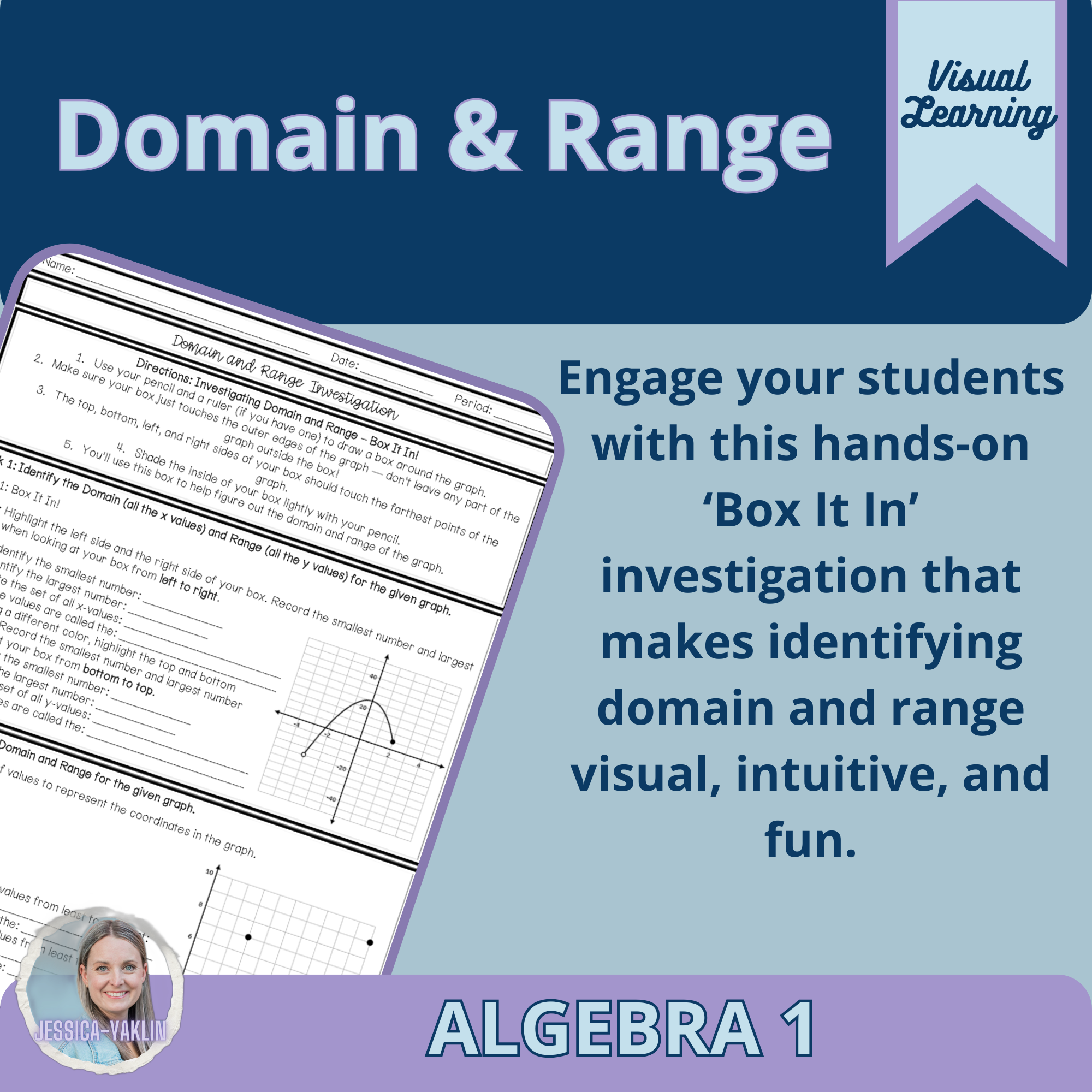
Boost your students’ understanding of domain and range with this highly engaging, visual, and hands-on math investigation. This activity teaches students a simple “Box It In” strategy for identifying domain (x-values) and range (y-values) from graphs. Making a traditionally tricky concept clear, concrete, and accessible. It’s perfect for warm-ups, math stations, partner work, review, test prep, or independent practice as students strengthen their understanding of functions.
Students will analyze graphs, tables, and function scenarios to determine domain and range, write inequalities, and distinguish between discrete and continuous data. The visual method helps students build confidence and develop foundational skills needed for Pre-Algebra, Algebra 1, and early function analysis.
What’s Included:
A visual “Box It In” reference page that teaches the domain and range strategy.
A student-friendly practice page for identifying domain and range from graphs.
A table-based practice page for analyzing discrete and continuous data.
Function scenarios that require students to interpret domain and range in real-world contexts.
Clear, step-by-step directions that make this activity easy to implement.
A reflection page that helps students deepen understanding and explain their reasoning.
Learning Objectives
Identify domain and range from graphs and tables.
Understand the difference between discrete and continuous functions.
Write domain and range using inequalities.
Apply a visual strategy to analyze functions.
Build foundational graphing and function interpretation skills.
How to Use This Resource:
This activity is a hands-on, visual way to help students master domain and range.
Students will begin by learning the “Box It In” method and practicing it with simple graphs.
Next, they will apply the strategy to tables and real-world scenarios, determining whether each situation represents discrete or continuous data.
Students will write domain and range using inequalities and complete a reflection page to solidify understanding.
Perfect as a no-prep math activity, engaging review lesson, test prep resource, or sub plan.
Perfect For…
Pre-Algebra, 8th Grade Math, and Algebra 1 classrooms.
Teachers looking for visual, student-friendly ways to teach domain and range.
Practicing and reviewing function concepts.
Math stations, partner activities, or independent practice.
Supporting visual, kinesthetic, and collaborative learners.
A no-prep printable activity for busy math teachers.
The Pedagogy: Why It Works
This resource blends algebraic thinking with visual learning. The “Box It In” method helps students see domain and range directly on the graph, making abstract concepts more concrete. Students move through natural scaffolding. From graphs to tables to real-world scenarios, building confidence as they apply the strategy in multiple contexts.
By connecting visual interpretation, inequality writing, and function analysis, this activity helps students develop a repeatable approach they can use throughout Pre-Algebra and Algebra 1. The reflection component encourages metacognition, helping students articulate their understanding and strengthen long-term retention.
Middle School Math Resources
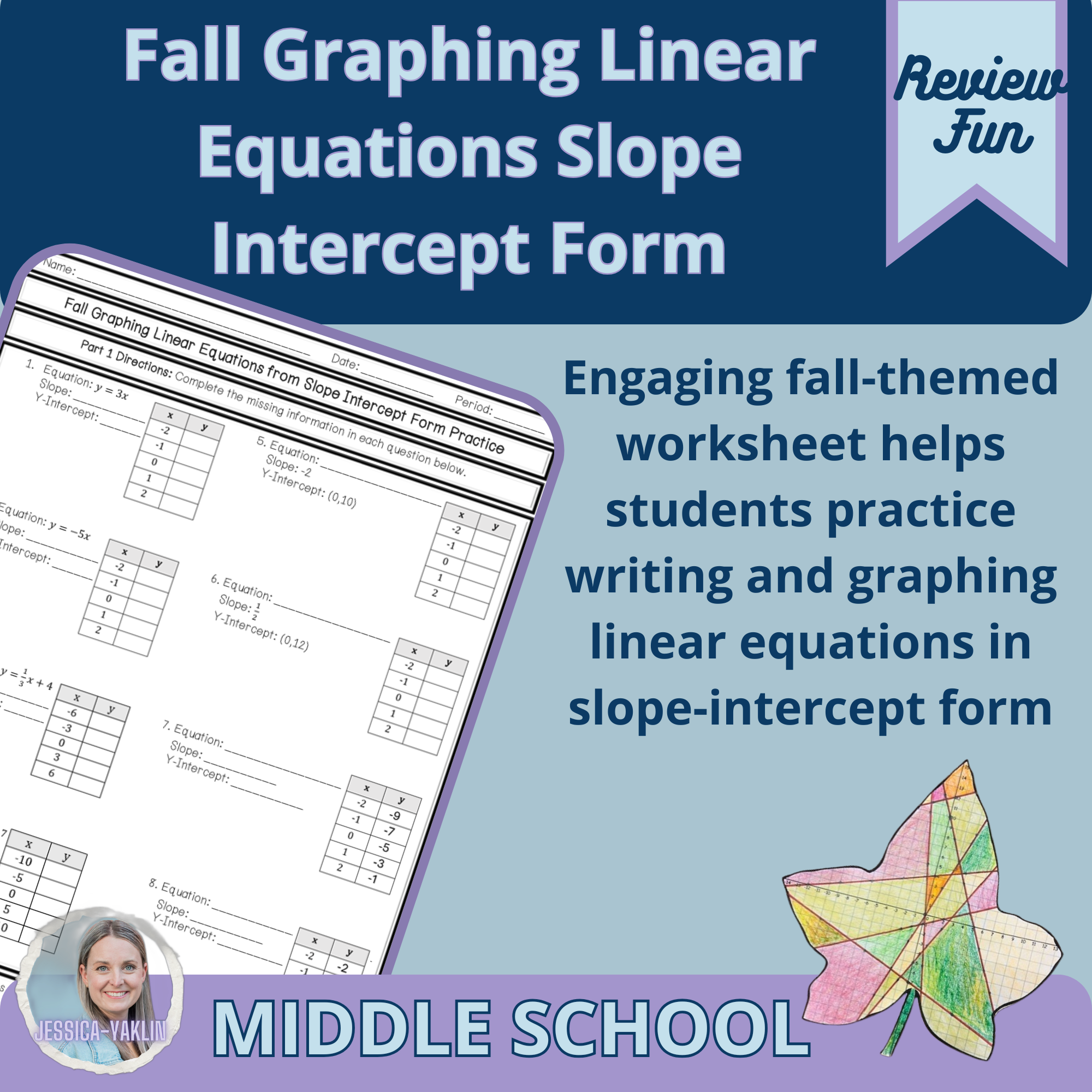
Make algebra festive with this Fall Graphing Linear Equations Activity! This engaging activity gives students meaningful practice writing and graphing linear equations in slope-intercept form while creating a colorful fall-themed design. Students strengthen their understanding of slope, y-intercept, and graphing lines as they transform their algebra work into a seasonal classroom display.
This Fall Linear Equations Graphing Activity blends algebra practice with creativity and hands-on learning. Students work through eight linear equation problems, identify key features of each equation, and graph the lines on coordinate planes. As they complete each problem, they can color and cut their finished pieces to create a festive fall display.
Students stay engaged because their mathematical accuracy contributes to a final visual product. The seasonal theme provides a fun change of pace from traditional worksheets while still giving students focused practice with important linear equations skills. The completed projects make a great autumn classroom decoration and allow students to showcase their hard work and mathematical understanding.
This resource is print-and-go and easy to implement, making it ideal for busy middle school and Algebra 1 classrooms, homeschool settings, or teachers looking for a creative way to reinforce linear equations.
What’s Included
• Fall-themed linear equations practice worksheet
• 8 problems involving equations in slope-intercept form
• Graphing sections for plotting, coloring, and cutting
• Clear, student-friendly directions
• Easy-to-use pages requiring minimal teacher preparation
Students will:
• Identify slope and y-intercept from a linear equation
• Write and interpret linear equations in slope-intercept form
• Graph linear equations accurately on a coordinate plane
• Connect algebraic equations to their visual representations
• Demonstrate understanding of slope and y-intercept through graphing
How to Use This Resource
This activity works well as independent practice, a small-group activity, math center, early-finisher task, or review lesson. Students begin by solving and analyzing each linear equation. They then graph each equation on the provided coordinate plane. Once their graphs are complete, students can color and cut the pieces to create the final fall-themed display.
Use this activity during a linear equations unit, before an assessment, or as a seasonal math activity when you want students practicing important algebra skills without relying on a traditional worksheet.
The Pedagogy: Why It Works
Students benefit from opportunities to connect symbolic, visual, and hands-on representations of mathematics. This activity requires students to move between the equation of a line and its graph, reinforcing the relationship between slope, y-intercept, and linear equations.
The creative component gives students an additional reason to work carefully. Accurate graphing helps create the final design, encouraging students to slow down, check their work, and pay attention to mathematical details. The fall theme also provides a fun way to bring seasonal energy into the math classroom while keeping the focus on meaningful algebra practice.
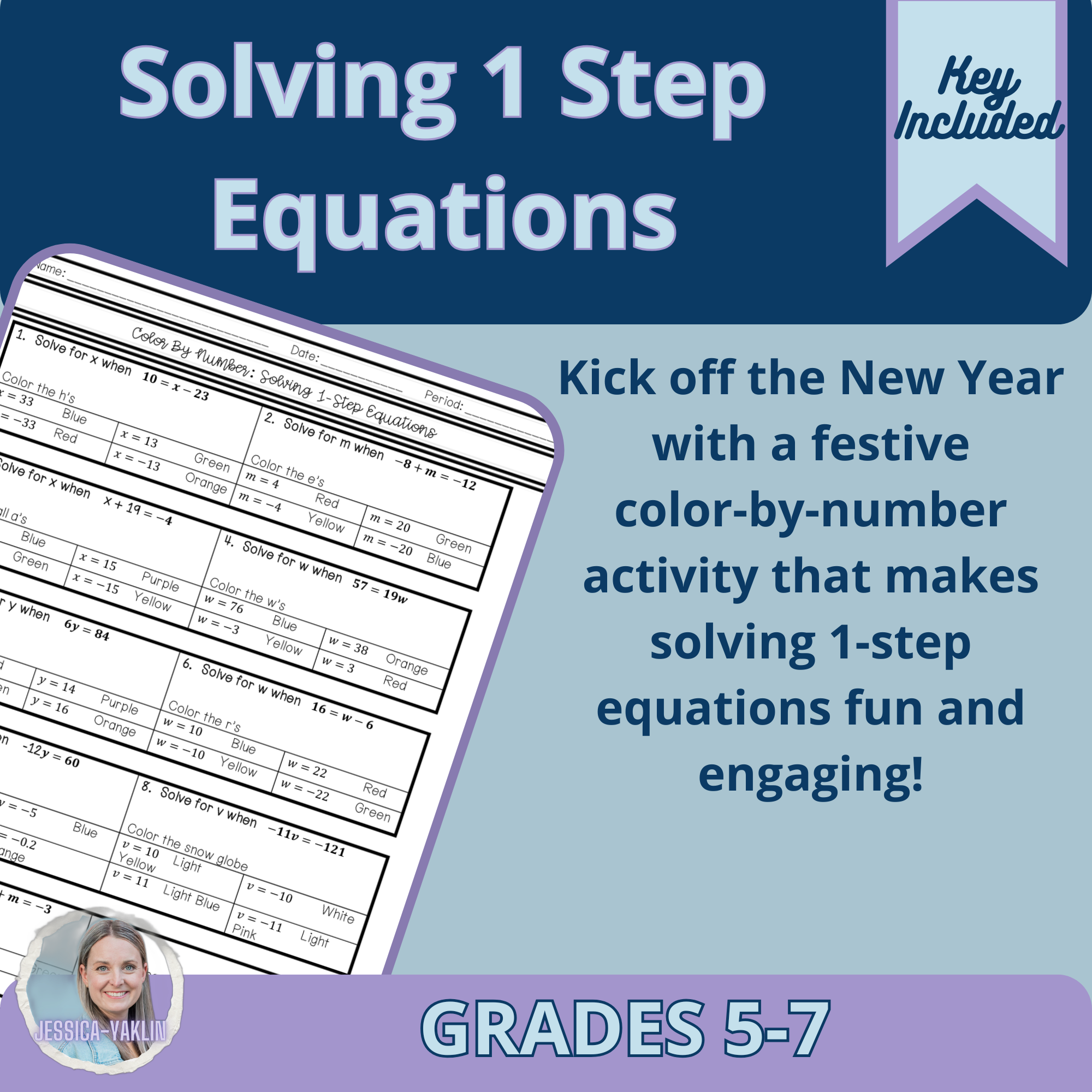
Help your students build algebra confidence from day one with this engaging Back to School One-Step Equations Color by Number Activity. This resource combines essential equation-solving practice with a growth mindset reflection to help students recognize that math skills grow through practice and perseverance. Perfect for the beginning of the school year, this activity gives students a fun and meaningful way to review solving one-step equations while creating a colorful math display.
Students will practice solving one-step equations involving addition, subtraction, multiplication, and division while connecting their solutions to a mystery picture. The finished coloring page creates an opportunity for students to celebrate their work, reflect on their math goals, and build confidence as they begin a new school year.
What's Included:
9 one-step equation practice problems with positive and negative solutions
Student-friendly color-by-number activity with a back-to-school themed design
Growth mindset reflection prompt where students write a personal math goal for the school year
Complete answer key for quick grading and easy teacher implementation
Ready-to-print student pages for a no-prep classroom activity
Learning Objectives:
Solve one-step equations using addition, subtraction, multiplication, and division
Apply integer operations when solving equations with positive and negative solutions
Build confidence and accuracy with foundational algebra skills
Reflect on personal learning goals and develop a growth mindset toward mathematics
Recognize that perseverance and practice help improve math ability
How to Use This Resource:
This activity is a fun and engaging way to reinforce one-step equations while creating a positive classroom environment.
Students will:
Solve each equation and determine the correct answer
Match their solutions to the corresponding colors
Reveal a completed back-to-school themed picture
Reflect on a personal math goal they want to work toward during the school year
The completed coloring page can be displayed in the classroom, added to student math portfolios, or used as a visual reminder of students’ goals and growth throughout the year.
Perfect for the first weeks of school, math review, independent practice, or a meaningful activity when students need a break from traditional worksheets.
Perfect For...
6th Grade, 7th Grade, and 8th Grade Mathematics classrooms
Beginning-of-the-year math activities
Reviewing foundational algebra skills
Building student confidence with equations
Growth mindset classroom activities
Math centers, stations, or independent practice
Early finisher activities
No-prep printable resources for busy teachers
The Pedagogy: Why It Works
This resource combines skill practice with reflection to support both mathematical growth and student confidence. By solving equations and seeing their answers transform into a completed visual, students receive immediate feedback while staying engaged in the learning process.
The growth mindset component encourages students to think about their goals, effort, and progress as mathematicians. Rather than viewing math ability as something fixed, students are reminded that consistent practice and perseverance help them strengthen their skills.
The structure of this activity provides built-in support for learners by moving from problem solving to visual representation and personal reflection. Students strengthen essential algebra foundations while developing the confidence they need for future math success.
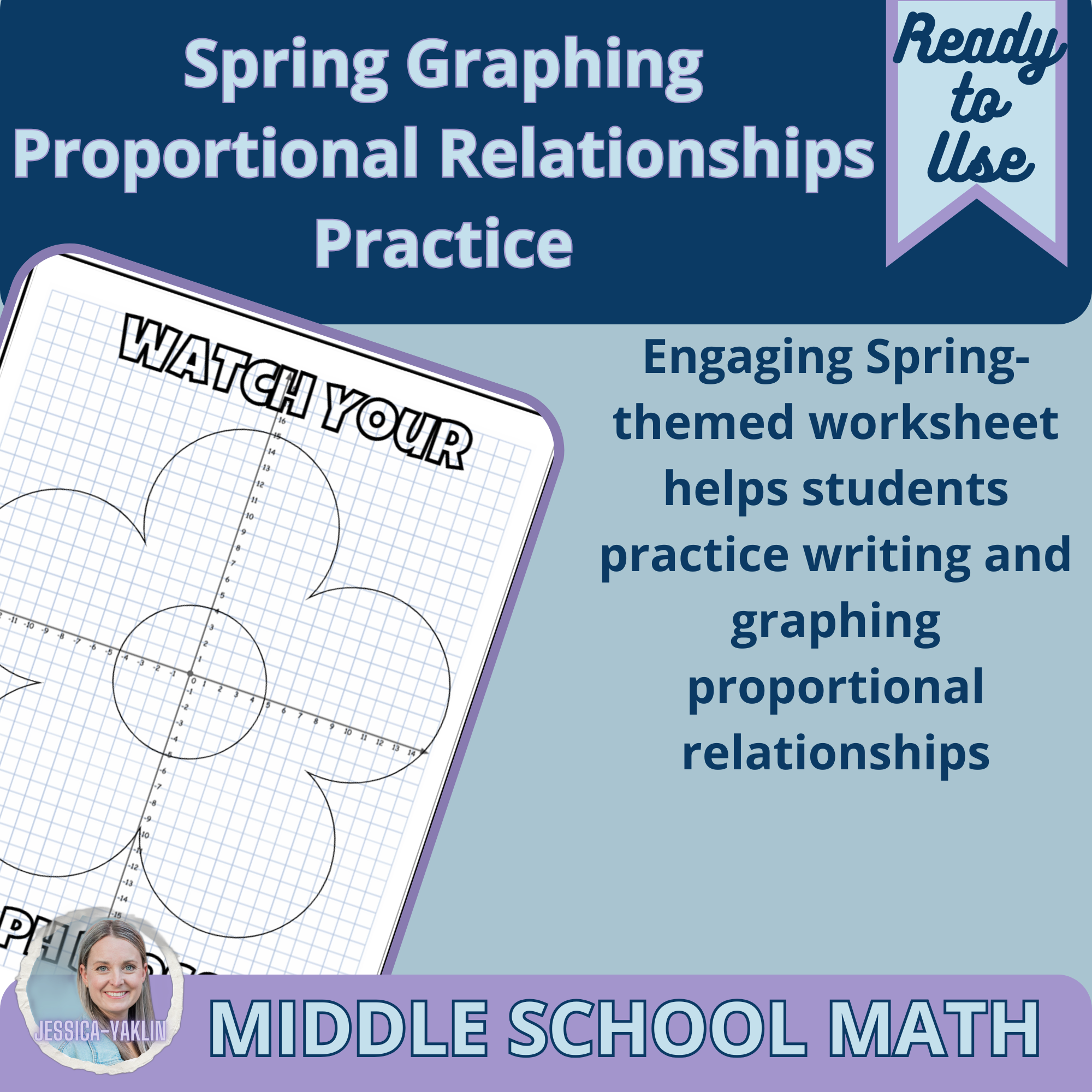
Give your students engaging, seasonal practice with graphing proportional relationships, identifying the constant rate of change, and working with linear equations in the form y=kx. This Spring-themed activity is perfect for warm-ups, stations, partner work, end of year review or independent practice as students strengthen their understanding of linear relationships. Final product is a fun coloring page perfect for bulletin boards.
What's Included:
8 linear equations presented in direct variation form, just waiting to be graphed!
A dedicated student sheet for easily identifying constant rate of change
A spacious graphing page where all eight equations will come together to form a cute Spring display.
Crystal-clear, step-by-step directions that make this activity a breeze to implement.
A stunning finished product that’s perfect for a vibrant bulletin board display that will wow everyone!
Learning Objectives
Master the art of graphing linear equations using the slope-intercept form (y = kx).
Confidently identify and interpret the constant rate of change.
Accurately plot coordinate points on the Cartesian plane.
Visually connect the algebraic representation of linear equations to their graphical representation.
How to Use This Resource:
This activity is a fantastic hands-on way to practice graphing linear equations in direct variation.
Students will first analyze each equation to find its constant rate of change.
As they graph all eight equations onto the provided grid, a beautiful coloring page will emerge!
The final product can be colored and displayed, making it a wonderful Spring bulletin board display or a festive takeaway.
Perfect as a no-prep holiday math lesson, a fun review activity, or an engaging sub plan.
Perfect For...
6th Grade, 7th Grade, and 8th Grade Mathematics classrooms.
Teachers looking for engaging spring-themed math activities.
Reviewing linear equations in a hands-on way.
Creating a festive and educational bulletin board display.
Students who benefit from visual and kinesthetic learning experiences.
A no-prep worksheet or printable activity for busy educators.
The Pedagogy: Why It Works
This resource is built around the power of hands-on activities. By physically graphing lines and seeing them form a cohesive image, students create a memorable connection between abstract algebraic concepts and visual outcomes. This multi-sensory approach reinforces learning and boosts retention, making the understanding of linear equations much more robust and enjoyable.
The project’s inherent structure, moving from equation analysis to plotting to artistic creation, provides a natural scaffolding that supports students of all levels. It encourages critical thinking as they interpret slope and intercept, and problem-solving as they ensure accurate plotting, all within a delightful, low-stakes holiday context.
Don't pass on this resource! Click Add to Cart now and sprinkle some graphing magic into your 6th, 7th, and 8th grade math classroom!
Summer Camp
*
Summer Camp *
To enroll in Summer Camp, visit the Course Login page, choose your child’s grade level, and select the tier that best fits your needs. I’ll take care of the rest!

Bring linear equations to life with this Halloween Jack-O’-Lantern Linear Equations Project! Students transform equations into a creative, spooky design as they graph lines and use their understanding of slope, equation forms, and linear relationships to build their own Jack-O’-Lantern masterpiece. By connecting algebraic equations to a visual design, students get meaningful practice with linear equations while creating a fun Halloween-themed project they’ll be proud to display.
This Halloween Linear Equations Project blends algebraic reasoning with hands-on creativity. Students write and graph linear equations in slope-intercept form, point-slope form, and standard form while incorporating parallel and perpendicular lines, domain and range restrictions, and transversals into their designs. An equation table organizer helps students keep track of their work, while reflection and concept questions encourage them to think beyond simply graphing each equation.
Students stay engaged because they are creating something rather than simply completing a traditional worksheet. Each equation becomes part of a larger visual design, giving students a reason to pay attention to accuracy and think carefully about how algebraic representations translate to a coordinate plane. The finished Jack-O’-Lanterns make a fun addition to a Halloween bulletin board or classroom display.
This resource is low-prep and easy to implement, making it perfect for a Halloween review activity, end-of-unit project, enrichment opportunity, or engaging lesson during the weeks leading up to Halloween.
What's Included
Creative Halloween Jack-O’-Lantern graphing project
Two different Jack-O’-Lantern templates
Step-by-step student directions
Equation table organizer for organizing and checking equations
Detailed project rubric for easy assessment
10 reflection and concept questions
Teacher instructions for implementation
Opportunities for students to graph by hand or digitally using Desmos
Learning Objectives
Students will:
Write and graph linear equations in slope-intercept, point-slope, and standard form.
Identify and apply relationships between parallel and perpendicular lines.
Use domain and range restrictions to create specific line segments.
Apply transversal concepts on a coordinate plane.
Connect equations, tables, and graphs to a visual representation.
Analyze and reflect on their mathematical thinking.
Communicate their understanding of linear equations through a creative project.
How to Use This Resource
This project works beautifully as a multi-day activity, end-of-unit assessment, or engaging Halloween review.
Students begin by reviewing the project requirements and organizing their equations using the equation table. They then graph each equation on their Jack-O’-Lantern template, paying close attention to slope, intercepts, equation form, restrictions, and line relationships. Students can complete their designs on paper or use Desmos to support the graphing process.
Once their Jack-O’-Lantern is complete, students answer the reflection and concept questions to explain their mathematical thinking. Finished projects can then be displayed around the classroom or on a Halloween bulletin board.
Perfect for:
Algebra 1 linear equations review
Slope and equation forms practice
End-of-unit projects
Halloween math activities
Graphing linear equations review
Geometry students reviewing algebra skills
Early finisher enrichment
Substitute plans or low-prep instructional days
Math bulletin board displays
Engaging pre-holiday classroom activities
The Pedagogy: Why It Works
Students often understand linear equations more deeply when they can see how equations, graphs, and visual representations connect. This project moves students beyond simply solving or graphing equations by requiring them to use mathematical constraints to create a specific design.
As students translate equations into line segments, analyze parallel and perpendicular relationships, and apply domain and range restrictions, they are constantly checking whether their algebraic work produces the intended graphical result. This encourages precision, problem solving, and mathematical reasoning.
The creative component gives students ownership of their work while making abstract algebra concepts more memorable. The reflection questions provide an opportunity for students to explain their reasoning and demonstrate conceptual understanding—not just produce a finished picture.
The result is a Halloween activity that feels fun and creative while still providing meaningful Algebra 1 practice with linear equations and graphing.