Math Fluency Doesn't Have to Mean Flashcards
After I published my last blog post, "Summer Math Doesn't Have to Feel Like Summer School," one comment came up over and over again.
"Kids need to know their math facts." I couldn't agree more. As a middle school math teacher and tutor, I find myself thinking the same thing almost every day. "This problem would be so much easier if you knew your math facts." or "You wouldn't have to work so hard if your number sense was stronger."
The truth is, many students struggle with math not because they can't understand the concepts, but because every problem feels like starting from scratch. When students don't have quick recall of basic facts or confidence with numbers, their brains become overloaded before they ever get to the actual math they're supposed to be learning.
Math Fluency Is About More Than Memorization
When people hear "math fluency," they often think of timed tests or endless flashcards. And let's be honest...Most kids don't get excited about flashcards. Many parents don't enjoy drilling flashcards either. Even if they work, they're usually not something children ask to do again tomorrow. I wanted something different.
I wanted students to practice mental math without feeling like they were practicing.
I wanted something families could pull out for 10 or 15 minutes after dinner.
I wanted something teachers could use for math centers, early finishers, tutoring sessions, or intervention groups.
Most importantly, I wanted students to have fun!
Turning a Deck of Cards into a Math Game
That's when I started thinking about one of my favorite childhood card games...
War.
Almost everyone knows how to play it, so why not give it a math twist? Instead of simply comparing two cards, players complete a math challenge before deciding who wins the round.
For example: Each player draws two cards. Multiply the two numbers together. Whoever has the larger product wins the cards. Simple. Fast. Fun.
But I didn't want students to outgrow the game after one afternoon.
So I created 11 different levels that gradually increase in difficulty. Players start with comparing numbers and basic operations, then build toward integer operations, simplifying expressions, and order of operations as their confidence grows. The repeated practice helps strengthen number sense, mental math, accuracy, and confidence while keeping students engaged.
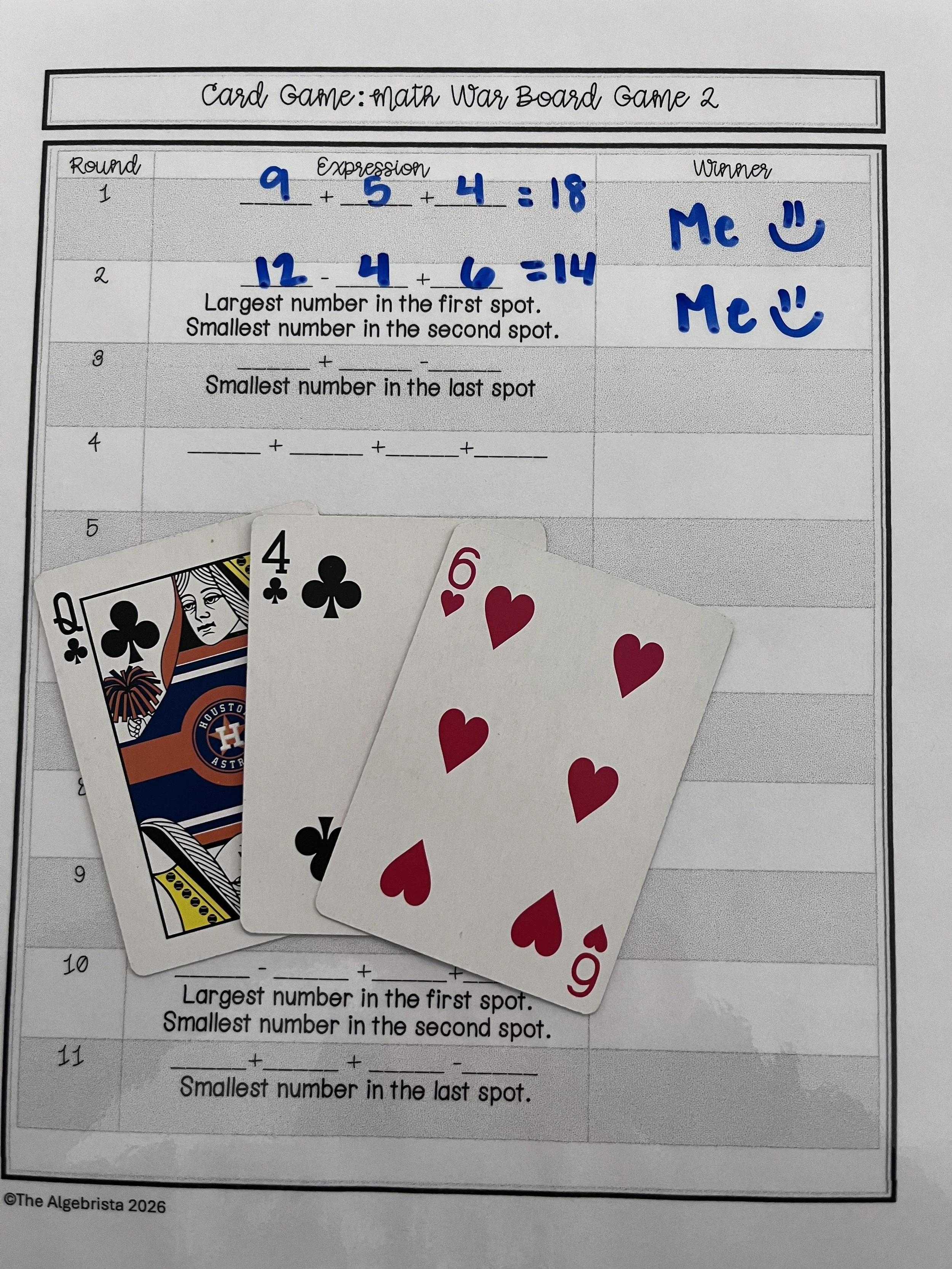
Example Game Borad with a round of cards.
The Best Part? Students Want to Play Again.
Recently I tried the game with one of the students I tutor. We played for quite a while, laughing, competing, and celebrating big wins. At the end she smiled and said, "I'm going to teach my grandma how to play so she'll play with me!"
As a teacher...I call that a success. When students voluntarily want to practice math with a family member, you've found something special.
Why Games Build Confidence
One of the biggest obstacles in math isn't ability. It's confidence. When practice feels like work, students often avoid it. When practice feels like a game, they ask for another round. Without realizing it, they're solving dozens of math problems, thinking flexibly about numbers, improving mental math, and building fluency one card at a time. That's exactly the kind of practice that sticks.
No Fancy Supplies Needed
One of my favorite things about this activity is how simple it is.
All you need is:
A standard deck of playing cards
Two players
A few minutes
That's it.
Whether you're a parent looking for a screen-free activity, a teacher planning math centers, or a tutor wanting something engaging, this game is easy to set up and easy to play.
Want to Skip the Planning?
If you'd rather have everything ready to go, I've created a printable Math War resource that includes:
Parent and teacher directions
Student-friendly directions
11 levels of play
5 reusable game boards
Print-and-play pages that work with any standard deck of cards
Whether your child is just building math fact fluency or is ready for integers and algebraic expressions, there's a level that's just right for them. Because building math confidence doesn't have to involve worksheets, flashcards, or tears. Sometimes...It just starts with a deck of cards.
I’d love to hear from you! If you try Math War with your child, comment below and let me know how it goes. What skills are you practicing? What other games or activities have helped your child build confidence in math?
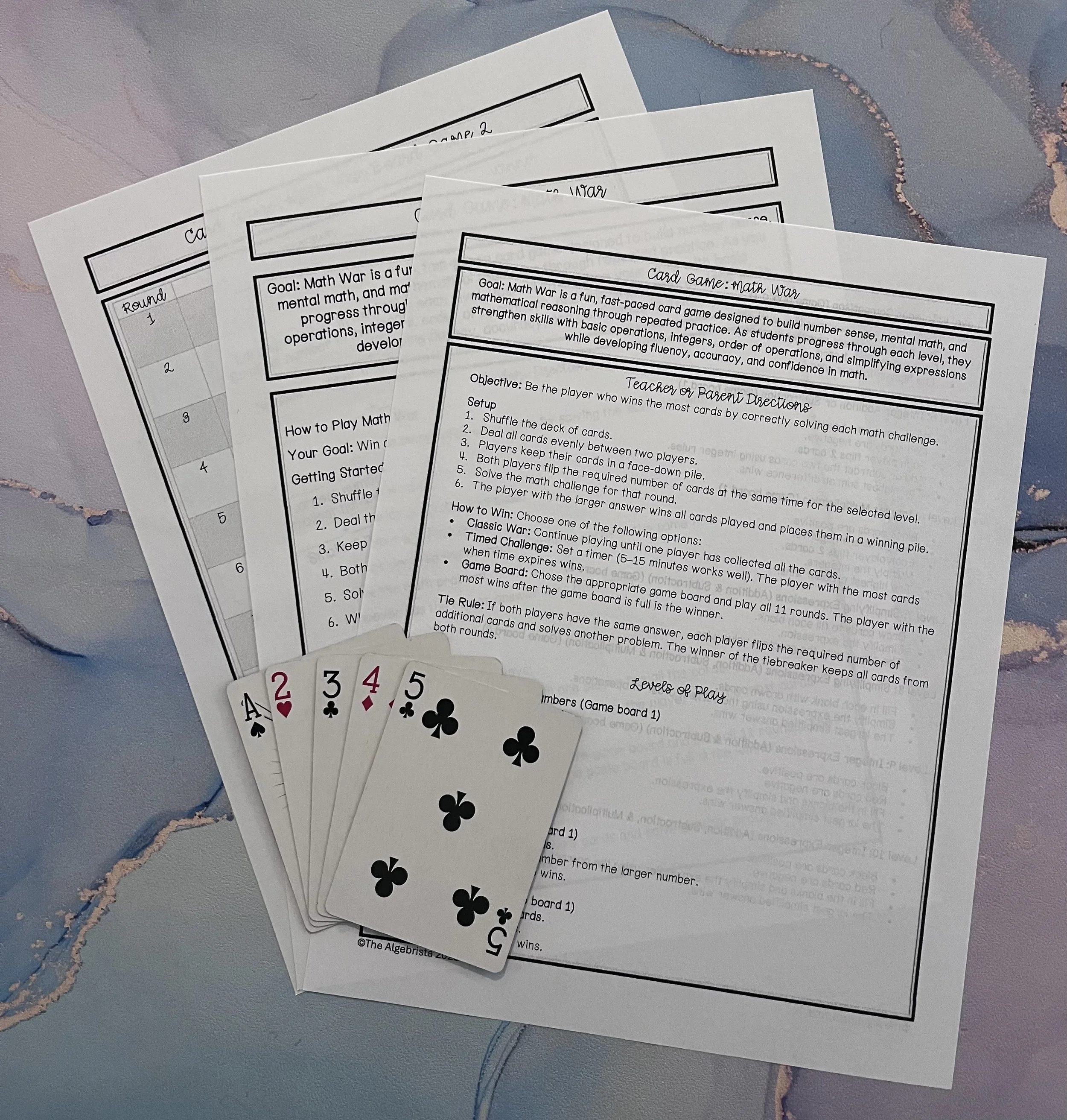
Pictured: Parent or Teacher Directions, Child friendly directions, 1 of 5 Game Cards