

Graph a Picture Project
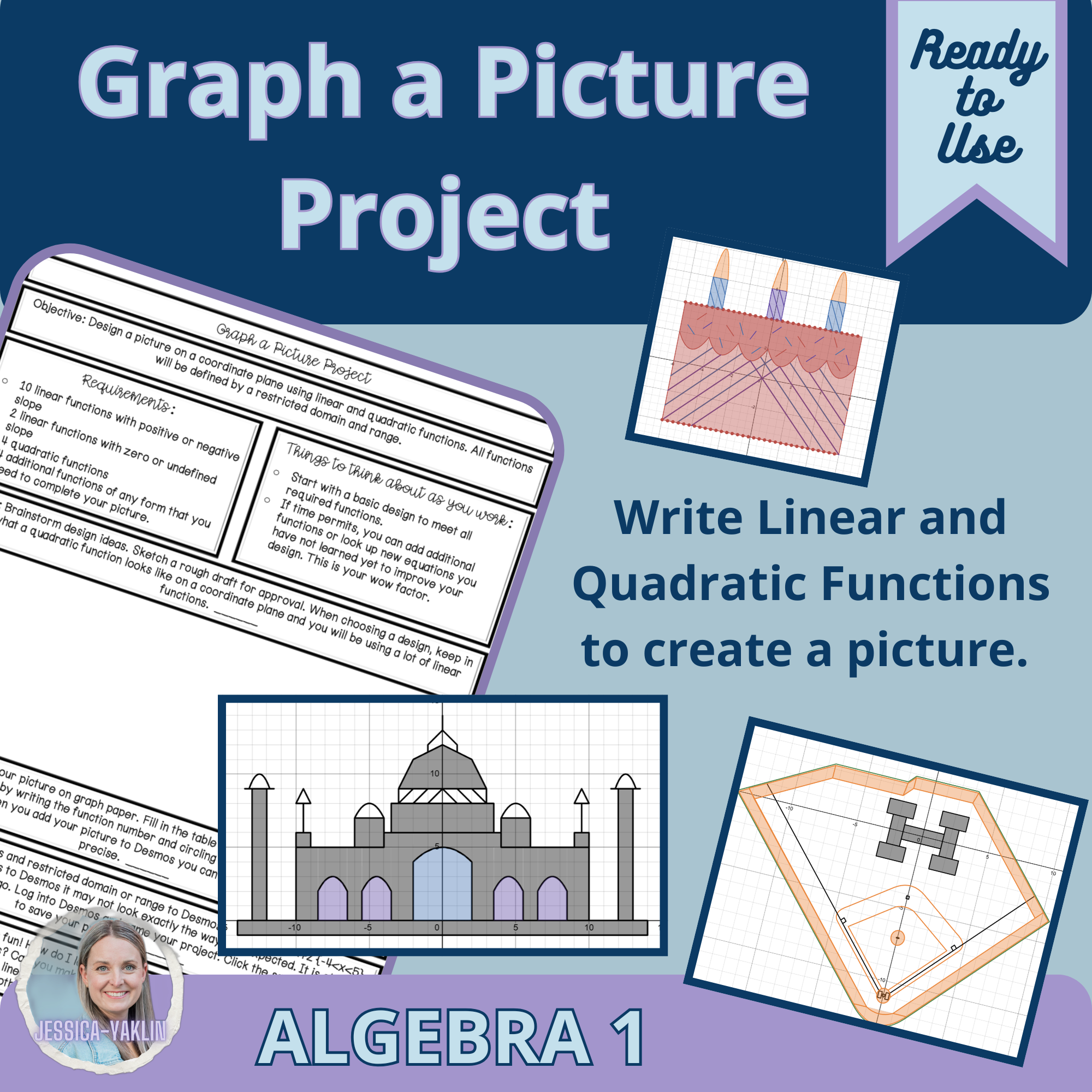
Turn algebra into a creative masterpiece with this Graph a Picture Project, where students design their own coordinate‑plane artwork using linear and quadratic functions. This hands‑on activity transforms abstract math concepts into visual art. Students bring their designs to life by writing equations, estimating domain and range, and transferring their work to Desmos for a polished digital version. With a balance of structure and creativity, this project reinforces algebraic understanding while giving students the freedom to create something uniquely their own.
✨ Why Students Love This Project
As students graph each function, their picture gradually appears—building excitement, ownership, and motivation. The artistic element keeps engagement high, while the math demands precision and conceptual understanding. Students must think critically about how linear and quadratic functions behave, how to restrict domains, and how to combine multiple equations to form a cohesive image.
📘 What’s Included
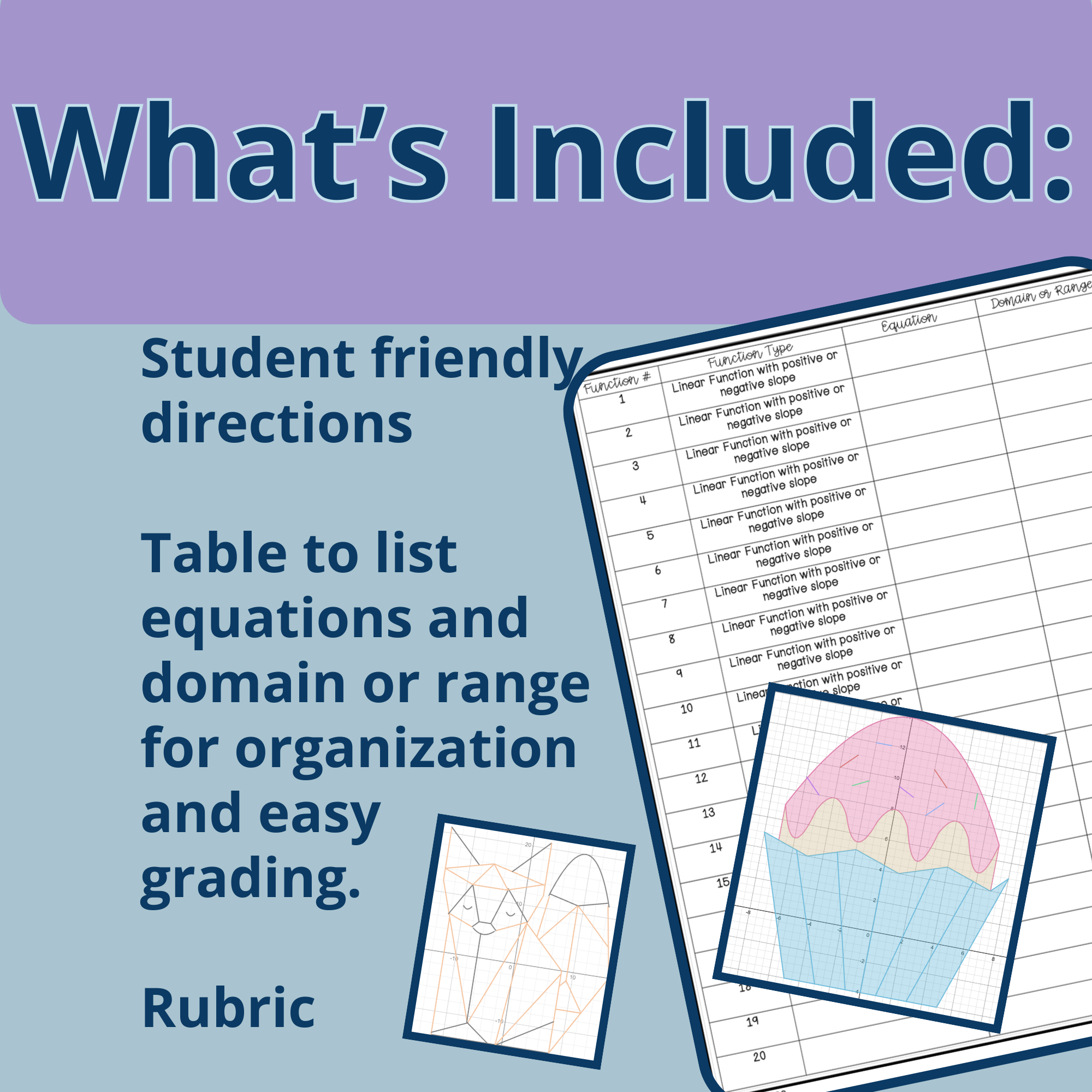
Step‑by‑step student directions for brainstorming, drafting, and graphing
Planning table for all 20 required functions (linear, quadratic, and student‑choice)
Clear instructions for transferring the project to Desmos
A detailed grading rubric aligned to your original criteria
🎯 Skills Students Will Build
Writing and graphing linear functions with positive, negative, zero, and undefined slopes
Graphing quadratic functions and understanding their shape on the coordinate plane
Applying domain and range restrictions to control the appearance of each segment
Using Desmos to refine precision and enhance their final design
Strengthening spatial reasoning, problem‑solving, and mathematical creativity
📚 Learning Objectives
Students will:
Identify and analyze key features of linear and quadratic functions
Write equations in multiple forms and apply them to a real design
Graph functions accurately with restricted domains and ranges
Combine multiple functions to create a cohesive image
Demonstrate conceptual understanding through a creative, visual project
💡 How to Use This Resource
This project works beautifully as:
An end‑of‑unit assessment for linear or quadratic functions
A multi‑day algebra project
A creative review activity
A math‑and‑art crossover lesson
An enrichment or early‑finisher challenge
A technology‑integrated assignment
🎨 Perfect For…
Algebra 1 and Algebra 2
8th grade linear & quadratic units
Teachers who want a rigorous but creative assessment
Students who enjoy visual learning and hands‑on math
End‑of‑year projects that feel meaningful and fun
🧠 The Pedagogy: Why It Works
Students learn best when they can see the math. This project connects algebraic rules to visual outcomes, helping students internalize how equations behave. By restricting domains and ranges, they gain a deeper understanding of function behavior and precision. The creative component boosts engagement, ownership, and pride—while still requiring strong algebraic reasoning.
Turn algebra into a creative masterpiece with this Graph a Picture Project, where students design their own coordinate‑plane artwork using linear and quadratic functions. This hands‑on activity transforms abstract math concepts into visual art. Students bring their designs to life by writing equations, estimating domain and range, and transferring their work to Desmos for a polished digital version. With a balance of structure and creativity, this project reinforces algebraic understanding while giving students the freedom to create something uniquely their own.
✨ Why Students Love This Project
As students graph each function, their picture gradually appears—building excitement, ownership, and motivation. The artistic element keeps engagement high, while the math demands precision and conceptual understanding. Students must think critically about how linear and quadratic functions behave, how to restrict domains, and how to combine multiple equations to form a cohesive image.
📘 What’s Included
Step‑by‑step student directions for brainstorming, drafting, and graphing
Planning table for all 20 required functions (linear, quadratic, and student‑choice)
Clear instructions for transferring the project to Desmos
A detailed grading rubric aligned to your original criteria
🎯 Skills Students Will Build
Writing and graphing linear functions with positive, negative, zero, and undefined slopes
Graphing quadratic functions and understanding their shape on the coordinate plane
Applying domain and range restrictions to control the appearance of each segment
Using Desmos to refine precision and enhance their final design
Strengthening spatial reasoning, problem‑solving, and mathematical creativity
📚 Learning Objectives
Students will:
Identify and analyze key features of linear and quadratic functions
Write equations in multiple forms and apply them to a real design
Graph functions accurately with restricted domains and ranges
Combine multiple functions to create a cohesive image
Demonstrate conceptual understanding through a creative, visual project
💡 How to Use This Resource
This project works beautifully as:
An end‑of‑unit assessment for linear or quadratic functions
A multi‑day algebra project
A creative review activity
A math‑and‑art crossover lesson
An enrichment or early‑finisher challenge
A technology‑integrated assignment
🎨 Perfect For…
Algebra 1 and Algebra 2
8th grade linear & quadratic units
Teachers who want a rigorous but creative assessment
Students who enjoy visual learning and hands‑on math
End‑of‑year projects that feel meaningful and fun
🧠 The Pedagogy: Why It Works
Students learn best when they can see the math. This project connects algebraic rules to visual outcomes, helping students internalize how equations behave. By restricting domains and ranges, they gain a deeper understanding of function behavior and precision. The creative component boosts engagement, ownership, and pride—while still requiring strong algebraic reasoning.