Parallel Lines Cut by a Transversal Project
$4.00
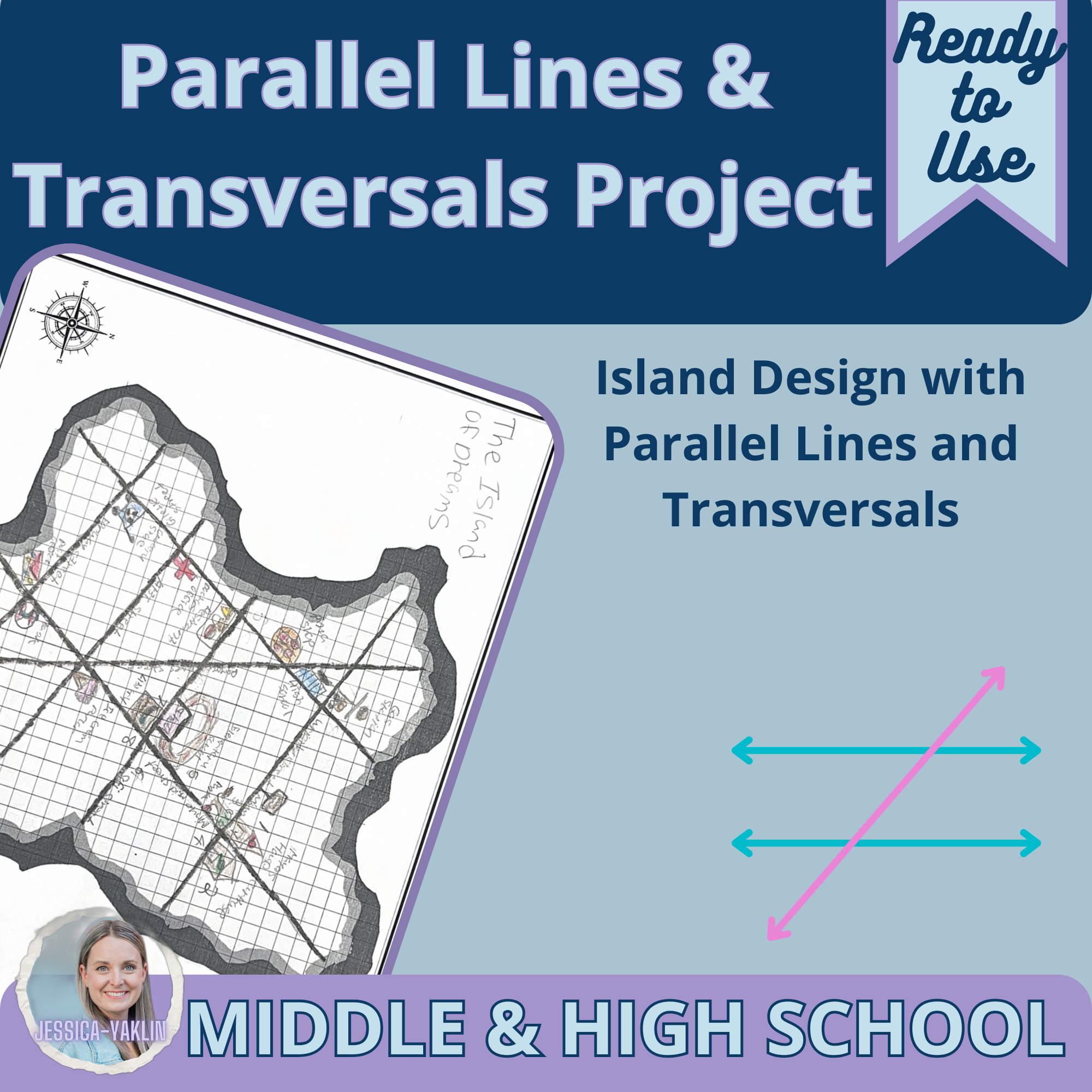
Bring parallel lines and transversals to life with this Private Island Parallel Lines and Transversals Project. Students become civil engineers as they design their own themed island, create a network of parallel streets and transversal roads, and strategically place buildings based on angle relationships. By connecting geometry vocabulary to a creative real-world scenario, students develop a deeper understanding of angle pair relationships while producing a colorful, one-of-a-kind island map.
This Parallel Lines and Transversals Project blends mathematical reasoning with hands-on creativity. Students begin by planning a private island complete with four parallel streets and two transversal roads. As they build their map, they place landmarks and businesses according to geometric relationships such as corresponding angles, alternate interior angles, alternate exterior angles, vertical angles, supplementary angles, and linear pairs. The project concludes with a partner challenge where students create and solve their own angle puzzle using algebraic reasoning and transversal vocabulary.
Students stay highly engaged because they are making meaningful decisions throughout the project rather than simply completing a worksheet. Designing a themed island, naming streets and businesses, and creating a peer challenge encourages ownership while reinforcing essential geometry concepts. Built-in creativity and problem solving make this an activity students genuinely enjoy.
This resource is fully print-and-go, making it perfect for busy classrooms, homeschool settings, or low-prep instructional days.
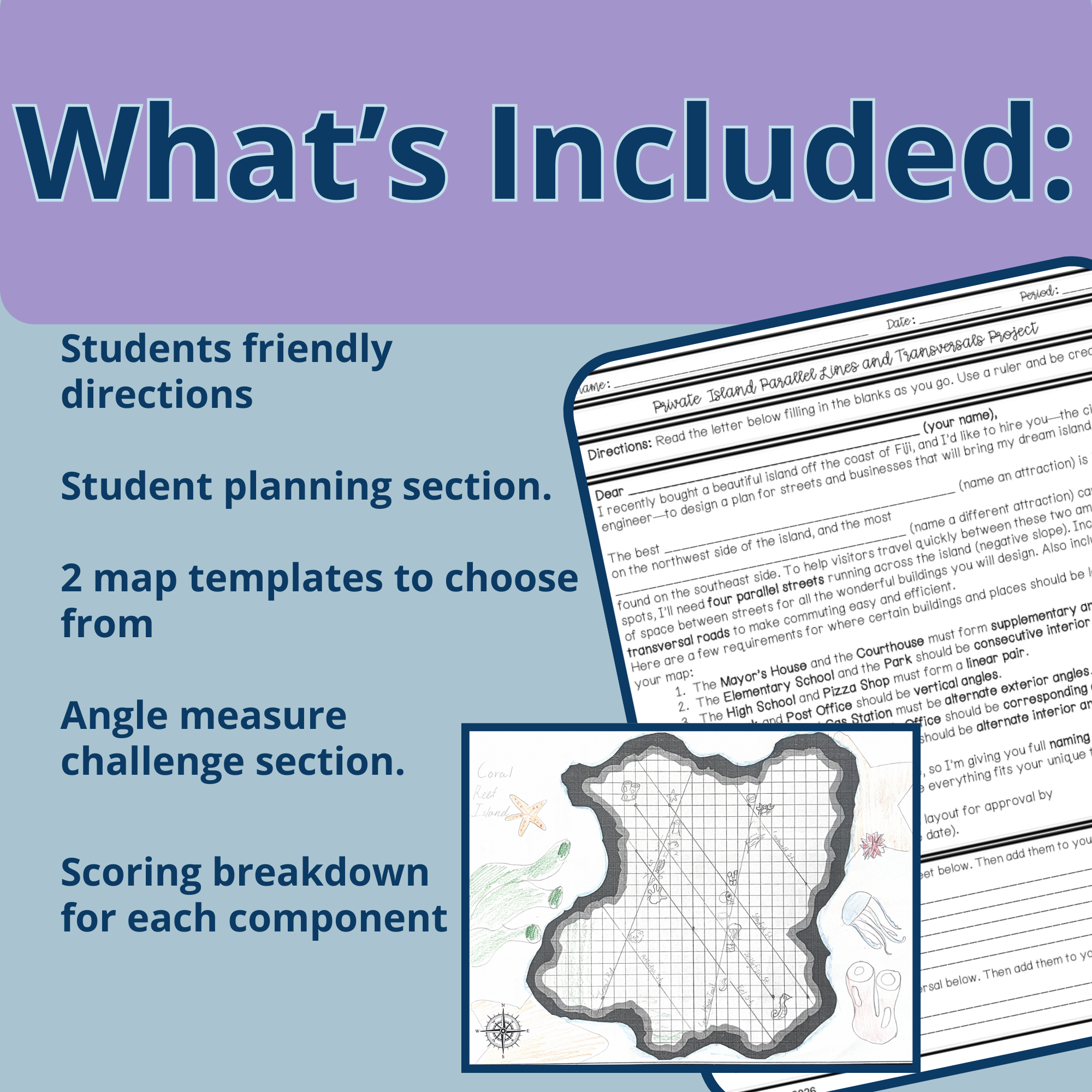
Creative island design project with engaging student scenario
Step-by-step student directions
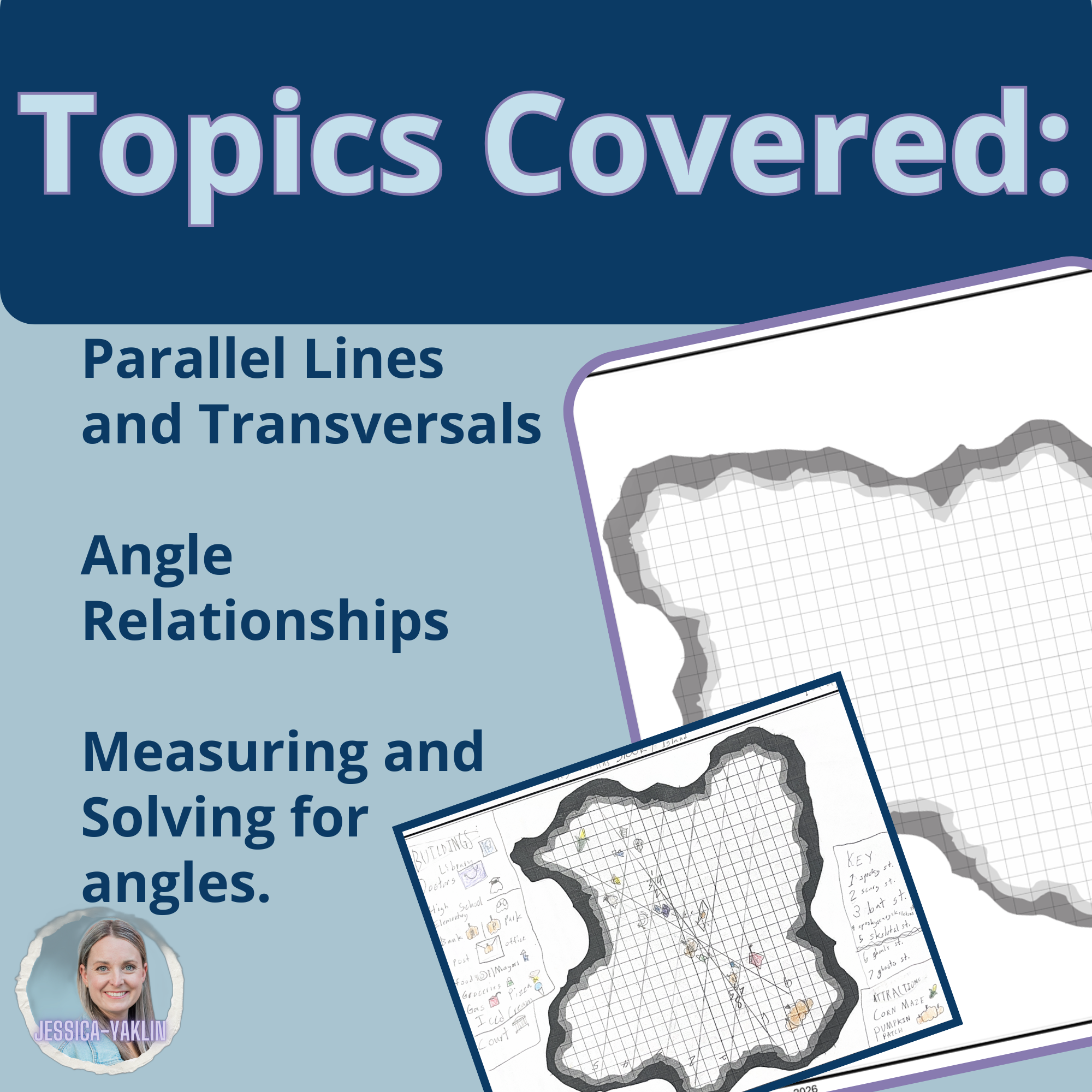
Printable island map templates
Building key for labeling landmarks and businesses
Geometry placement tasks using angle relationships
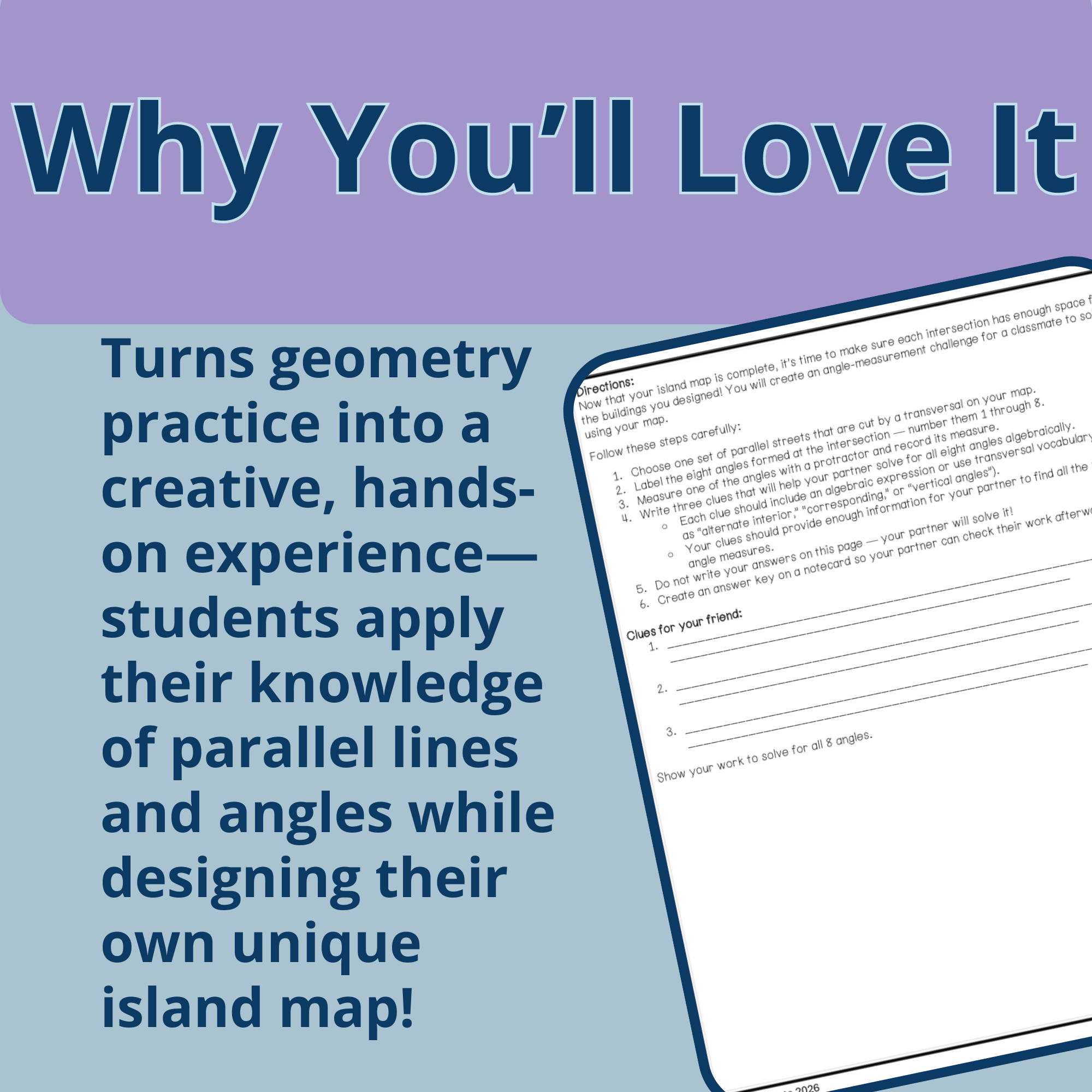
Student-created partner challenge for solving angle measures
Detailed grading rubric for easy assessment
Students will:
Identify and apply angle relationships formed by parallel lines and transversals.
Distinguish between corresponding, alternate interior, alternate exterior, vertical, supplementary, and linear pair angles.
Use mathematical vocabulary in a meaningful context.
Create and label a geometric map using precise mathematical relationships.
Construct and solve angle measurement problems using algebraic reasoning.
Communicate mathematical thinking through a creative design project.
This project works beautifully as a multi-day activity, end-of-unit assessment, or engaging review lesson.
Students begin by designing a themed private island and drawing four parallel streets with two transversal roads. They then place buildings at specific angle relationships, label their map, and complete a visual key. Finally, students create their own angle-measurement challenge for a classmate by writing clues using algebraic expressions and transversal vocabulary before solving the puzzle themselves.
Perfect for:
End-of-unit assessments
Parallel lines and transversals review
Geometry enrichment activities
Early finisher projects
Math centers
Homeschool lessons
Sub plans or low-prep instructional days
Students understand geometry more deeply when they apply concepts in meaningful contexts instead of memorizing vocabulary. This project requires students to analyze angle relationships, justify their placement decisions, and communicate mathematical reasoning throughout the activity. Designing their own island transforms abstract geometry concepts into an engaging visual experience.
The addition of the peer-created angle challenge extends learning beyond identification by requiring students to think like both the teacher and the learner. Creating clues, using algebraic reasoning, and solving for unknown angles strengthens conceptual understanding while promoting higher-order thinking. The final island map provides students with a sense of ownership and accomplishment while reinforcing essential geometry standards.
Bring parallel lines and transversals to life with this Private Island Parallel Lines and Transversals Project. Students become civil engineers as they design their own themed island, create a network of parallel streets and transversal roads, and strategically place buildings based on angle relationships. By connecting geometry vocabulary to a creative real-world scenario, students develop a deeper understanding of angle pair relationships while producing a colorful, one-of-a-kind island map.
This Parallel Lines and Transversals Project blends mathematical reasoning with hands-on creativity. Students begin by planning a private island complete with four parallel streets and two transversal roads. As they build their map, they place landmarks and businesses according to geometric relationships such as corresponding angles, alternate interior angles, alternate exterior angles, vertical angles, supplementary angles, and linear pairs. The project concludes with a partner challenge where students create and solve their own angle puzzle using algebraic reasoning and transversal vocabulary.
Students stay highly engaged because they are making meaningful decisions throughout the project rather than simply completing a worksheet. Designing a themed island, naming streets and businesses, and creating a peer challenge encourages ownership while reinforcing essential geometry concepts. Built-in creativity and problem solving make this an activity students genuinely enjoy.
This resource is fully print-and-go, making it perfect for busy classrooms, homeschool settings, or low-prep instructional days.
Creative island design project with engaging student scenario
Step-by-step student directions
Printable island map templates
Building key for labeling landmarks and businesses
Geometry placement tasks using angle relationships
Student-created partner challenge for solving angle measures
Detailed grading rubric for easy assessment
Students will:
Identify and apply angle relationships formed by parallel lines and transversals.
Distinguish between corresponding, alternate interior, alternate exterior, vertical, supplementary, and linear pair angles.
Use mathematical vocabulary in a meaningful context.
Create and label a geometric map using precise mathematical relationships.
Construct and solve angle measurement problems using algebraic reasoning.
Communicate mathematical thinking through a creative design project.
This project works beautifully as a multi-day activity, end-of-unit assessment, or engaging review lesson.
Students begin by designing a themed private island and drawing four parallel streets with two transversal roads. They then place buildings at specific angle relationships, label their map, and complete a visual key. Finally, students create their own angle-measurement challenge for a classmate by writing clues using algebraic expressions and transversal vocabulary before solving the puzzle themselves.
Perfect for:
End-of-unit assessments
Parallel lines and transversals review
Geometry enrichment activities
Early finisher projects
Math centers
Homeschool lessons
Sub plans or low-prep instructional days
Students understand geometry more deeply when they apply concepts in meaningful contexts instead of memorizing vocabulary. This project requires students to analyze angle relationships, justify their placement decisions, and communicate mathematical reasoning throughout the activity. Designing their own island transforms abstract geometry concepts into an engaging visual experience.
The addition of the peer-created angle challenge extends learning beyond identification by requiring students to think like both the teacher and the learner. Creating clues, using algebraic reasoning, and solving for unknown angles strengthens conceptual understanding while promoting higher-order thinking. The final island map provides students with a sense of ownership and accomplishment while reinforcing essential geometry standards.